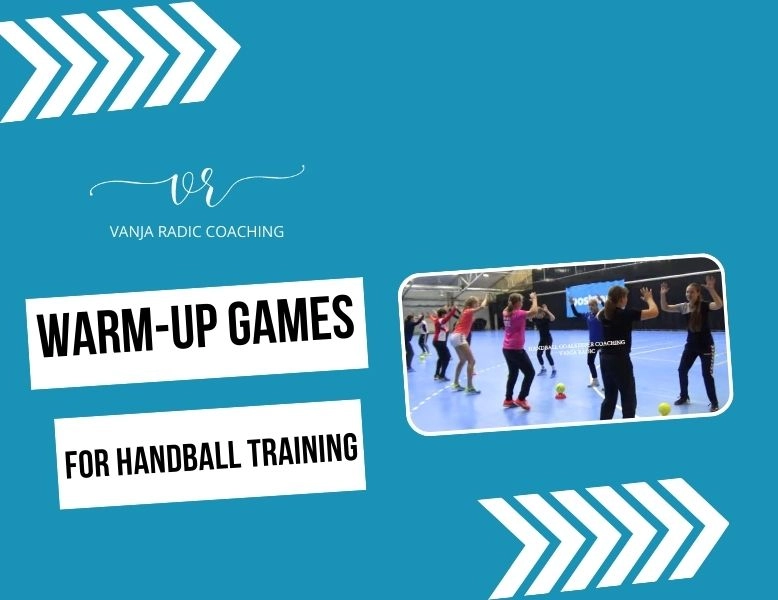
Warm-Up Games for Handball Training
I’ve coached goalkeepers and players across more than 30 countries over the past two decades, and if there’s one thing I’ve learned, it’s this: how you start your practice shapes everything that follows. The first 10 – 15 minutes of any training session set the tone for the entire hour or two ahead.
Yet warm-up is often treated as an afterthought. Players jog around the court, sometimes do some half-hearted stretches, and then jump straight into drills. Or they do a great warm-up routine, but it’s always only “serious”. That approach misses the point entirely, especially when you are working with young athletes. A good warm-up does more than raise body temperature. It prepares the mind. It brings the team together. It creates energy that carries through the whole session.
That’s why I’ve collected a few warm-up games for handball that I’ve used successfully with groups ranging from 8-year-old juniors to professional senior teams. These games work because they’re fun, physically effective, and mentally engaging all at once. Let me share them with you.
Key Takeaways
- Warm-up games for handball prepare the body and mind simultaneously. A well-designed game raises heart rate and body temperature while also shifting athletes’ attention from daily stress to the training ahead. This dual preparation improves the quality of everything that follows.
- Fun creates better engagement than routine. When athletes enjoy the start of practice, they participate more fully. Half-hearted warm-up provides half-hearted preparation. Games generate genuine enthusiasm across all age groups.
- Cognitive warm-up is just as important as physical warm-up. Games that require quick decision-making, information filtering, and processing speed prepare the brain for the demands of handball, not just the body.
- These games work for all age groups and team sizes. From junior players to senior professionals, I’ve tested these warm-up games with hundreds of groups. The reactions are consistently positive because the games are simple enough to understand immediately yet challenging enough to remain engaging.
- Variation keeps warm-up fresh over time. By adding rules, signals, or modifications, you can use the same base games throughout a season without athletes getting bored.
Why Warm-Up Games Work Better Than Traditional Warm-Up
Before diving into specific warm-up games for handball, let me explain why game-based warm-up outperforms traditional jogging and stretching.
Progressive intensity happens naturally. In a game, players start slower as they figure out the rules, then intensity builds as competition increases. This mirrors exactly what the body needs for safe preparation.
Full body involvement is guaranteed. Players run, jump, reach, twist, and move in all directions. This engages multiple muscle groups and movement patterns rather than isolating single areas.
Mental engagement is built in. Players must track the ball, read other players’ movements, make quick decisions, and execute motor skills under time pressure. This prepares the brain for the decision-making demands of training.
Team connection develops. Athletes who might have arrived individually now interact and connect. The energy in the gym shifts from scattered individuals to a unified group ready to work together.
The Physical Importance of Proper Warm-Up
When athletes arrive at practice, their muscles are cold and joints are stiff. Cold muscles are less elastic and more prone to strains and tears. Blood isn’t flowing efficiently to working muscles, and the cardiovascular system is at resting levels.
A proper warm-up gradually increases body temperature. As core temperature rises, muscles become more pliable and joints produce more synovial fluid (the lubricant that allows smooth joint movement). Blood vessels dilate, improving oxygen delivery. Heart rate increases gradually, preparing the cardiovascular system for higher intensity work.
Skip the warm-up, and you’re asking cold, unprepared bodies to perform explosive movements. That’s how injuries happen.
For goalkeepers especially, warm-up games for handball prepare them for explosive lateral movements, quick directional changes, and reactive responses they’ll need during save practice. Starting especially goalkeeper training without adequate warm-up is asking for trouble.
The Mental Side of Warming Up
Warm-up isn’t just physical. It’s also mental transition time.
Athletes arrive at practice carrying stress from school, work, or personal life. Their minds might be anywhere except on handball. A good warm-up game helps athletes shift their attention to the present moment and to the training ahead.
The playful nature of these games creates positive associations with practice. When training starts with fun, athletes engage more fully in everything that follows. Their focus improves. Their willingness to work hard increases. The overall quality of the training session goes up because athletes are mentally present and positively engaged.
Game – “Smash Ball”
I love using this game when working with a group of goalkeepers, but the Smash Ball warm-up works equally well for field players. Over the years, I’ve introduced this game to countless groups, and the reaction is always the same: they love it.
Equipment
For this game, you can use (recycle) the inner part of an old handball ball that you planned to throw away anyway. Instead of discarding it, you can make an interesting warm-up game for your team.
The soft, irregular-shaped ball creates unique training benefits:
Reduced injury risk. The soft material means players can hit it aggressively without hurting their hands. Collisions with the ball don’t cause the same impact as a regular handball.
Unpredictable movement. The irregular shape means the ball doesn’t travel in straight lines or bounce predictably. This trains players to react to unexpected situations.
Accessibility. You’re using something that would otherwise be thrown away. This makes the game accessible for any team regardless of budget.
Rules
The rules of Smash Ball are simple:
Team setup: Make two teams that will play against each other. Team sizes can vary depending on your group size and available space.
No carrying the ball: Players can’t dribble, hold, or carry the ball at any point. Normal handball throws and passes are not allowed. Players can only smash the ball with their hand.
Hitting the ball: Players should hit or smash the ball with their hand. You can agree on different rules here, but I don’t let them kick the ball with feet because that would end up in someone’s foot colliding with someone’s fingers.
Direction of hits: Players can smash the ball to fly in the air, or they can bounce it toward the floor. They can smash from above, below, the sides, any direction.
No fixed goalkeeper: There is no goalkeeper positioned in front of the goal. But whoever happens to be in front of the goal when the ball is coming toward it can save the shot. You can agree on whether that person is allowed to use feet or legs.
The objective: Score in the opponent’s goal. And most importantly: have fun!
Variations
You can add different variations during the game. For example, you can have players do different kinds of things after you give an audio signal (a whistle). Or you can combine two different tasks depending on whether you whistle once or twice.
Here are some ideas:
Movement variations: On a whistle, all players must do five jumping jacks before continuing. Or everyone must touch the floor with both hands. Or all players sprint to touch a sideline and back.
Team switching: On a whistle, players immediately switch teams and now play for the opposite side. This creates chaos and laughter while keeping everyone alert.
Restricted body parts: After a signal, players can only use their non-dominant hand. Or they must hit the ball while in a low athletic stance.
Cognitive challenges: Call out a color, and only players wearing that color can score for the next 30 seconds. Or call out a number, and that many players from each team must sit out temporarily.
Tempo changes: Whistle once for slow motion play, whistle twice for maximum speed. This teaches body control and intensity management.
You can be as creative as you want and make this warm-up game even more interesting, dynamic, and fun!
Benefits for Goalkeepers
While Smash Ball works well for all players, goalkeepers gain particular benefits:
Reactive training. The unpredictable ball path trains the quick reactions goalkeepers need during saves. Eyes must track an irregular trajectory and hands must respond accordingly.
Movement in all directions. Goalkeepers move laterally, forward, back, and diagonally during the game. This prepares them for the multidirectional demands of their position.
Reading situations. Goalkeepers must read where the ball is going based on incomplete information, just like in actual game situations. This develops anticipation skills in a low-pressure environment.
Integration with field players. Goalkeepers often warm up separately from the team. The Smash Ball game allows them to warm up together with everyone, building team connection.
Game – Numbers and Ball (Cognitive Warm-Up)
This warm-up game for handball focuses on cognitive preparation. It trains processing speed, attention filtering, and reaction time in a simple but effective format.
How It Works
Assign certain numbers to body parts that players should touch with both hands after you say the number out loud. For example:
- “1” = touch shoulders
- “3” = touch knees
- “5” = touch hips
- “BALL” = grab the ball as fast as possible
You can use numbers, colors, countries, names, or any category that works for your group.
The Filtering Challenge
Here’s where it gets interesting. Include numbers or words that are NOT assigned to any body part. When players hear those, they shouldn’t do anything.
For example, if you call out “6” and that number wasn’t assigned to anything, players must resist the urge to react. They have to filter out irrelevant information while still processing everything at high speed.
Why This Works
This game trains several cognitive skills that directly transfer to handball performance:
Processing speed. Players must hear, interpret, and respond quickly. No time to think.
Selective attention. They must filter relevant information from irrelevant information while under pressure.
Response inhibition. Sometimes the correct response is no response. This trains impulse control.
Dual-task performance. Players maintain a ready position while also processing auditory information.
Variations
Multiple commands: Call out two or three numbers in quick succession. Players must remember and execute all of them.
Movement additions: Add running, shuffling, or jumping between commands.
Competition: The last person to grab the ball does a small penalty like five push-ups or jumping jacks.
Visual signals: Instead of calling out numbers, hold up fingers or colored cards. This trains visual processing instead of auditory.
Where Warm-Up Games Fit in Your Training Session
These warm-up games for handball typically work best as the second or third phase of warm-up, after initial light movement and dynamic stretching. Here’s how it might fit into a full warm-up sequence:
Phase 1 (3-5 minutes): Light jogging, skipping, side shuffles to increase heart rate and blood flow.
Phase 2 (5-8 minutes): Dynamic stretching including leg swings, arm circles, hip rotations, and movement-based flexibility work.
Phase 3 (8-12 minutes): Warm-up game. The competitive element raises intensity while the fun keeps energy positive.
Phase 4 (3-5 minutes): Sport-specific activation like passing patterns or position-specific movements.
This progression takes athletes from rest to full training readiness in a systematic, safe manner. The game provides the high-energy, game-like activity that bridges general preparation and specific training.
Additional Handball Warm-Up Resources
Here are a few other warm-up ideas you can explore for your team:
- 7 Warm Up Games for Handball by Handball Inspires
- 3 Catching Games for Warm Up by Handball Inspires
- Specific Handball Warm Up Flow by Handball Inspires
- Warming up Games and Small Games by Branislav Pokrajac and EHF
Having a variety of warm-up options keeps your training sessions fresh and prevents athletes from becoming bored with the same routine every day.
Conclusion
These warm-up games for handball are simple, fun, and effective ways to start your training sessions. They require minimal equipment, work for all age groups from juniors to seniors, and deliver genuine physical and mental preparation.
More than that, they remind us that warm-up doesn’t have to be boring, or always only serious. When athletes enjoy the start of practice, everything that follows benefits. Energy stays high. Focus stays sharp. The team connects.
Try these games with your team and see how they respond. I’ve yet to find a group that doesn’t love them. And once you see how a fun, engaging warm-up changes the quality of your entire training session, you’ll never underestimate the importance of those first minutes of practice again.
Stay in Touch
Do you have any coaching challenges you’d like me to address? Let me know what topics you struggle with most in goalkeeper coaching by filling out this form.
Never miss an update
Subscribe to my newsletter to receive updates about my online and in-person projects, research papers, creative projects (blog posts, books, e-books), and new online programs.
My Online Video Courses:
– Level 1 Video Course for Coaches
– Level 2 Video Course for Coaches
– Sliding Technique Video Course
– Agility Ladder Drills Video Collection – 102 drills
Subject to Copyright
Unauthorized use and/or duplication of any content from this website without express written permission from this site’s owner is strictly prohibited. All content (including text, data, graphics files, images, illustrations, videos, and sound files) contained in www.vanjaradic.fi is copyrighted unless otherwise noted and is the property of Vanja Radic Coaching. If you wish to cite or use any content from my website, please contact me first to obtain permission.
4 Responses
It’s excellent! Very funny and good for warming up.
Keep going! 🙂
I used it with many different age groups, and all of them LOVED this funny game! 🙂 From 8 years old juniors until seniors team. 🙂
Nice game, can you tell me which type of ball is used?
Thank you 🙂
Keeo going 😉
Hello Petr, the answer to your question is in the first sentence in the text: “You can use inner part of old handball ball which you planned to throw away and make interesting warming up game for your team” 🙂 So – it’s inner part of any handball ball. 🙂 Thank you! And just so you know – kids are loving this game!!!! 🙂