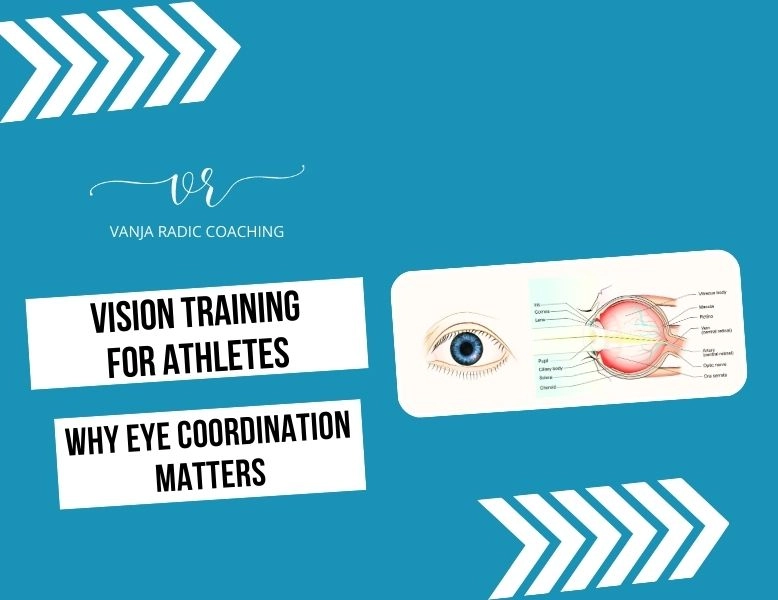
Vision Training for Athletes: Why Eye Coordination Matters
Last updated: March 2026
What if I told you that the reason an athlete is struggling to catch a ball, misjudging distances, or reacting too late has nothing to do with their physical abilities? What if the problem isn’t their reflexes, coordination, or training intensity, but something far more fundamental that has gone completely unnoticed?
Vision training for athletes is one of the most underutilized yet impactful approaches to improving sports performance. More than 80% of the sensory information athletes process during competition is visual. Yet most coaches, trainers, and even athletes themselves treat vision as a fixed trait rather than a trainable skill. This is a significant oversight.
I’ve been researching and applying vision training principles in my coaching work for several years now, and the results have been nothing short of stunning. Even more stunning is how many athletes I’ve worked with have had vision problems that went completely unnoticed throughout their entire lives, despite regular eye exams. These hidden issues affected their performance in ways nobody suspected until we started looking at how their eyes actually work together.
In this article, I want to share everything I’ve learned about vision training for athletes, with a special focus on a critical skill called eye convergence. Whether you’re a coach, an athlete, or a parent of a young athlete who struggles with catching, tracking, or reacting to fast-moving objects, this information could change everything.
Key Takeaways
- Vision is a trainable skill, not a fixed trait – Just like strength, speed, and endurance, visual abilities can be developed and improved through targeted training. Athletes with superior visual processing have measurable competitive advantages.
- Eyesight and vision are not the same thing – Having 20/20 eyesight means you can see clearly when sitting still. But sports require dynamic visual skills like tracking, depth perception, and eye coordination that standard eye exams don’t measure.
- Eye convergence problems are common and often undetected – When the eyes can’t work together properly to focus on close or moving objects, it creates problems with hand-eye coordination, depth perception, and reaction timing. Standard eye exams often miss these issues.
- Vision training for athletes improves both performance and injury prevention – Research shows that visual training programs can improve reaction time, spatial awareness, and decision-making while also reducing injury risk, particularly concussions.
- Improvement is possible at any age – The brain’s neuroplastic ability to adapt means that visual skills can be developed and refined throughout life. Athletes who address visual deficiencies often experience significant performance improvements.
The Difference Between Eyesight and Vision
Before we go deeper into vision training for athletes, we need to establish a critical distinction that most people don’t understand.
Eyesight refers to how clearly you can see. It’s what the standard eye chart measures. When your eye doctor says you have 20/20 vision, they mean you can see clearly at 20 feet what a person with normal eyesight should be able to see at 20 feet. Eyesight is about the optical clarity of the image reaching your retina.
Vision is something entirely different. Vision refers to how your brain interprets, processes, and responds to visual information. It encompasses a wide range of dynamic skills:
- Eye tracking: Following a moving object smoothly and accurately
- Eye teaming: Both eyes working together as a coordinated pair
- Depth perception: Judging distances and spatial relationships accurately
- Peripheral awareness: Detecting movement and objects outside your direct line of sight
- Visual reaction time: How quickly you respond to what you see
- Focus flexibility: Shifting focus between near and far objects quickly
- Visual memory: Retaining and recalling visual information
Here’s the critical point: you can have perfect 20/20 eyesight and still have significant vision problems. Many athletes pass standard eye exams with flying colors while struggling with functional vision issues that directly impact their performance.
This is why vision training for athletes matters so much. We’re not talking about getting glasses or contact lenses. We’re talking about training the visual system to process information more efficiently and effectively.
Why Vision Matters So Much in Sports
Think about what happens when a goalkeeper faces a shot. In fractions of a second, they must:
- Track the ball from the shooter’s hand
- Estimate the ball’s trajectory and speed
- Determine where the ball will arrive
- Coordinate a physical response to that location
- Execute the save movement with precise timing
Every single one of these steps depends on vision. If any part of the visual processing chain is compromised, the entire sequence breaks down. The goalkeeper might see the ball clearly (good eyesight) but still react too late or move to the wrong position (compromised vision).
Research confirms this connection between vision and athletic performance. Studies have shown that professional and collegiate athletes demonstrate superior visual acuity, improved contrast sensitivity, and better visual tracking abilities compared to non-athletes. The visual skills gap between elite and recreational athletes is real and measurable.
But here’s the good news from the research: these visual skills are trainable. Vision training for athletes can narrow that gap and develop the same visual abilities that distinguish top performers from average players.
Understanding Eye Convergence
Of all the visual skills that affect athletic performance, eye convergence deserves special attention. This is a skill I pay very close attention to in my work with goalkeepers, and addressing convergence problems has produced some of the most dramatic improvements I’ve seen.
Convergence is the coordinated movement and focus of both eyes inward when looking at close objects. When you look at your finger held close to your nose, both eyes should turn inward together to focus on it. This coordinated movement happens automatically thousands of times every day.
Convergence insufficiency is a condition where the eyes struggle to work together properly when focusing on near objects or tracking moving targets. Instead of converging smoothly and staying focused, one or both eyes drift outward. This creates problems that extend far beyond simple discomfort.
According to the Cleveland Clinic, convergence insufficiency affects between 2% and 13% of the population. But in my experience working with athletes, the actual number with some degree of convergence difficulty is much higher than most people realize.
What Convergence Problems Cause
When an athlete has convergence insufficiency, they may experience:
- Double vision or blurred vision, especially during close work
- Eye strain and fatigue during practice and competition
- Headaches during or after visual concentration
- Difficulty tracking moving objects like a ball in flight
- Poor depth perception and misjudging distances
- Reduced hand-eye coordination
- Slower reaction time to visual stimuli
- Difficulty concentrating and maintaining focus
- Motion sickness or dizziness during fast movement
For athletes, these symptoms translate directly into performance problems. A baseball player might consistently swing late. A goalkeeper might misjudge where the ball is heading. A basketball player might struggle with free throws despite practicing for hours.
Why Convergence Problems Go Undetected
One of the most frustrating aspects of convergence insufficiency is how commonly it goes undiagnosed. Standard eye exams focus on eyesight, not vision. They test whether you can read letters on a chart while sitting still. They don’t test whether your eyes can track a moving object, work together as a team, or converge properly when focusing on near targets.
I’ve worked with athletes who had their eyes checked regularly by eye care professionals for years without anyone detecting convergence problems. This isn’t necessarily the fault of the eye doctors. Standard screenings simply aren’t designed to catch these functional vision issues.
This is why vision training for athletes should include convergence assessment and training. If you’re working with athletes who struggle with catching, tracking, or reacting to moving objects, convergence is one of the first things to check.
My Research on Convergence in Handball Goalkeepers
At the end of 2023, the seventh edition of the EHF Scientific Conference was held in Portugal. As an EHF Expert, I had the privilege of contributing two research papers on topics that I believe are critically important but underexplored in handball:
- Unveiling the Hidden Dangers of Concussions: The Invisible and Underrated Risk in Handball Goalkeeping
- Consequences and Frequency of Convergence Insufficiency in Handball Goalkeepers
I am grateful, humbled, and honored to be able to contribute to handball in this way. Both concussions and vision training are extremely important topics in handball goalkeeping, and we all need more research and more conversations about them.
The Visual Skills Athletes Need
Vision training for athletes targets specific visual abilities that impact sports performance. Let me break down the most important ones:
1. Dynamic Visual Acuity
This is the ability to see clearly while you or the object you’re looking at (or both) are moving. Static visual acuity (reading an eye chart) is very different from dynamic visual acuity (tracking a ball while running). Research shows that athletes with better dynamic visual acuity perform better in sports requiring object tracking and interception.
2. Eye Tracking and Pursuit
Smooth pursuit eye movements allow you to follow a moving object continuously. Saccadic eye movements are quick jumps from one point to another. Both types are essential for sports. Poor tracking ability means the brain receives interrupted or incomplete visual information about moving objects.
3. Depth Perception (Stereopsis)
Depth perception depends on having both eyes work together to create binocular vision. Each eye captures a slightly different perspective, and the brain combines these into a three-dimensional image. Athletes need accurate depth perception to judge distances, speeds, and spatial relationships. Poor stereopsis makes it difficult to accurately assess where a ball or opponent actually is in space.
4. Peripheral Vision
While central vision provides detailed information, peripheral vision detects movement and provides spatial awareness. Athletes need strong peripheral awareness to track teammates, opponents, and objects outside their direct focus. Training can expand and sharpen peripheral visual processing.
5. Visual Reaction Time
This is the time between seeing a stimulus and initiating a physical response. Faster visual reaction time gives athletes more time to process information and execute movements. This skill is particularly critical in fast-paced sports where milliseconds matter.
6. Focus Flexibility (Accommodation)
The ability to quickly and accurately shift focus between near and far objects affects many sports. A tennis player must switch focus from the ball leaving their opponent’s racket to the ball arriving at their own racket. Slow or inaccurate focus changes compromise timing and accuracy.
7. Eye-Hand Coordination
This is the integration of visual information with motor control. The eyes gather information, the brain processes it, and the body executes a coordinated response. Weaknesses anywhere in this chain affect overall coordination.
How Vision Training Works
Vision training for athletes uses structured exercises to develop and refine visual skills. Unlike general physical training, visual training specifically targets the neural pathways involved in visual processing.
The brain is neuroplastic, meaning it can adapt and reorganize in response to practice and experience. This applies to visual processing just as much as it applies to motor skills. With consistent, targeted training, athletes can measurably improve their visual abilities.
Types of Vision Training Approaches
Eye movement exercises train the muscles that control eye position and movement. These include convergence exercises, tracking drills, and saccadic exercises.
Visual-cognitive training combines visual tasks with decision-making challenges. Athletes might track objects while simultaneously processing other information, training the brain to handle complex visual scenes.
Stroboscopic training uses intermittent visual conditions (like glasses that flash between clear and opaque) to challenge the visual system. Research shows this type of training can improve attention, timing, and anticipatory skills.
Virtual reality training allows athletes to practice visual skills in simulated game situations, providing repetitions that would be impossible in real settings.
Sport-specific visual drills integrate visual training into regular practice, challenging visual skills within the context of actual sports movements.
Research on Effectiveness
A systematic review published by Taylor & Francis examined 126 studies on sports vision training. The review found that most studies reported improvements in both generic visual abilities and sports-specific visual skills. Many studies also reported benefits in actual sports performance, though the researchers noted that the field needs more rigorous methodology.
Research published in PubMed similarly found that visual training can benefit athletes in injury prevention and lead to improved sports performance and motor function at any age. The research showed that athletes can acquire adaptive motor behavior even when the visual system is impaired, due to task repetition and familiarity.
The evidence is clear: vision training for athletes is not “pseudoscience”. It’s a legitimate approach to performance improvement backed by growing research.
Why Visual Warm-Up Matters at the Start of Practice
Just as you wouldn’t ask athletes to sprint or lift heavy weights without warming up their bodies, you shouldn’t expect optimal visual performance without preparing the visual system.
Visual warm-up prepares the eyes and brain for the demands of training. Consider what happens when athletes arrive at practice. Their eyes have likely been looking at screens, books, or other near-distance objects. The eye muscles have been relatively static. The visual processing system has been operating at a low-demand level.
Then practice starts, and suddenly the visual system must track fast-moving objects, judge distances, process peripheral information, and coordinate with rapid body movements. Without preparation, this sudden shift can lead to slower reactions, poorer tracking, and increased visual fatigue throughout the session.
Benefits of Visual Warm-Up
Activates eye muscles. Just like skeletal muscles, the muscles controlling eye movement benefit from gradual warm-up before high-demand activity.
Improves blood flow to the visual system. Increased circulation to the eyes and visual processing areas of the brain optimizes function.
Calibrates depth perception. Moving from indoor, close-focus environments to outdoor, variable-distance sports requires the visual system to recalibrate.
Sharpens tracking ability. Smooth pursuit and saccadic eye movements improve with brief activation exercises.
Transitions attention. Visual warm-up helps athletes shift focus from daily distractions to the specific visual demands of their sport.
Reduces visual fatigue. A properly warmed-up visual system sustains performance better throughout long training sessions.
A Real-World Case Study: The Young Water Polo Player
Let me share a story that perfectly illustrates why vision training for athletes matters so much, and why eye convergence deserves special attention.
Several years ago, I started working with a 12-year-old boy who trained water polo. His parents contacted me because he struggled to catch a ball during practices, and they mentioned that he also had reading challenges: lack of intonation during reading, skipping letters or words, skipping rows, and generally refusing to read.
During our first session, the boy told me about his water polo practices and how much he enjoyed them. The only problem was, as he said: “No one throws the ball to me…”
I asked him why that was. He just lowered his head and told me quietly and sadly: “Because I can’t catch it…”
That moment broke my heart. Here was a young athlete who loved his sport but was being excluded because of a problem nobody understood.
I made a deal with him that we would work on it and improve it for sure. I’ve spent my whole life in handball, and catching and throwing balls is what we do. I knew there had to be a solution.
We did several sessions primarily focusing on cognitive coordination, improving speed of information processing, vision training, and unusual movements that challenge the brain in different ways, activating both hemispheres and as many areas as possible simultaneously.
The Discovery
During our second session, we did some eye movement exercises, and I realized something critical: the boy couldn’t cross his eyes voluntarily. It was literally impossible for him to do it. He could only cross his eyes while watching his finger placed upon the tip of his nose. As soon as he moved the finger away, his eyes would uncross.
I asked his mother to take a photo of him trying to look at his finger on the tip of his nose.
When I saw the photo, I was stunned. His left eye stayed looking straight ahead while his right eye was looking at the finger on his nose. It was immediately clear that his left eye was not converging properly. The coordination of that movement was significantly compromised.
This was the first photo that I have got:


I was stunned and surprised after I saw this picture! His left eye stayed somehow looking straight ahead while his right eye was looking at the finger on the middle of his nose! It was so clear that his left eye did not converge and it was lacking the proper coordination of the movement.
This was textbook convergence insufficiency. His eyes couldn’t work together to focus on close objects or track moving targets effectively. No wonder he couldn’t catch a ball. His depth perception was compromised. His eyes literally couldn’t give his brain the information it needed to accurately judge where the ball was in space.
The Training Program
A very interesting fact: this boy had his eyes checked regularly by an eye care professional for the last 4 years. But after learning everything I’ve learned about vision versus eyesight, I wasn’t surprised that this problem went undetected. Standard eye exams simply don’t test for convergence insufficiency.
I tested his eye movements, focusing ability, and visual acuity. I figured out which exercises would help him and designed a specific program for him. He did three sets of 3-4 eye exercises, each set 4-5 times per day for 14 days. Each set lasted between 5-10 minutes. He did one set in the morning before school and 3-4 more times after school, before going to sleep.
He was incredibly dedicated. After the first 14 days, we retested and took new photos. There was small but visible improvement in his eye convergence.
This was his situation after those first 14 days:


Comparison of eyes position from the first and second photo:

Small improvement was hardly visible, and there was needed more work to be done! I knew I should find the best drills for his eyes and for his brain, so I continued testing and re-assessing. He was willing to do more of the exercises and his parents were delighted already with this small improvement that we have made!
We continued for two more weeks with new set of exercises, three times per day. The improvement continued, but his left eye still wasn’t converging the same way as his right eye. So we did one more week with new set of exercises, just twice per day.
The Results
After about five weeks of intense vision training, the final results were remarkable.


Comparison of eyes position before the start of vision training program we have done and in the end (5 weeks later):

His eye convergence was finally working properly! 🙂 🙂 🙂 His both eyes now moved together to focus on close objects. The before-and-after comparison photos showed an obvious and dramatic improvement.
But here’s what mattered most: his vision actually also improved, not just his eye convergence. When we started, vision in his left eye was 20/50 and in his right eye was 20/25. After five weeks of applying different vision exercises, vision in his left eye improved to 20/25 and in his right eye to 20/15.
His parents reported improvements in his motivation and ability to read. And he told me that now his water polo teammates are throwing the ball to him during practices and games, and he is actually able to catch it.
From “no one throws the ball to me” to being a full participant on his team! That’s the power of vision training for athletes.
How to Check for Convergence Problems
After working with that water polo player, I started paying special attention to eye convergence in all the goalkeepers and athletes I work with. I also started testing it with friends who came over for coffee. 😀 I was amazed at how many people have convergence problems that affect their daily lives without knowing it!
Here’s how you can do a simple convergence check:
The Near Point of Convergence Test
- Have the athlete sit comfortably and look straight ahead
- Hold a small target (pen tip, pencil, or your finger) at arm’s length, directly in front of their nose
- Slowly move the target toward their nose while they keep it in single, clear focus
- Watch their eyes carefully as you move the target closer
- Note the point where:
- They report seeing double
- One eye turns outward (breaks convergence)
- They can no longer keep the target clear
Normal convergence: Both eyes should be able to converge smoothly and maintain focus until the target is about 2-3 inches from the nose (about 5-7 cm).
Possible convergence insufficiency: If one eye drifts outward before the target reaches 4 inches from the nose (about 10 cm), or if they report double vision at that distance, there may be a convergence problem worth investigating.
The Cross-Eye Test
Ask the athlete to cross their eyes voluntarily, without using a finger or target to focus on. Can they do it easily? Can they hold it? Some people with convergence insufficiency find this difficult or impossible.
Then have them look at their finger held at the tip of their nose. Both eyes should turn inward equally. Take a photo while they do this. You might see (like I did with the water polo player) that one eye isn’t converging properly.
When to Seek Professional Help
If you notice convergence issues, the athlete should see an eye care professional who specializes in functional vision, not just a standard eye exam. Look for:
- A developmental optometrist
- An optometrist specializing in vision therapy
- A sports vision specialist
Professionals in this field can perform comprehensive testing and design appropriate treatment programs.
Implementing Vision Training in Your Coaching
If you’re a coach who wants to incorporate vision training for athletes into your program, here are practical steps to get started:
Start with Assessment
Before training, assess where your athletes stand when it comes to their vision skills. Simple tests for tracking, convergence, peripheral awareness, and visual reaction time can identify athletes who might benefit most from focused vision work.
Pay attention to patterns. Which athletes consistently misjudge distances? Who reacts late to visual cues? Who struggles with catching a ball, or tracking despite adequate physical ability? These patterns might indicate visual deficiencies.
Incorporate Visual Elements into Existing Drills
You don’t need special equipment to add some elements of visual training to practice. Simple modifications to existing drills can challenge visual skills:
- Use different colored balls and call out which color to catch
- Have athletes track objects in their peripheral vision while executing skills
- Add audio or visual distractions that athletes must filter out
- Vary ball trajectories to challenge tracking and prediction
- Use smaller or camouflaged objects that demand sharper visual attention
Dedicate Time for Specific Visual Training
Beyond modifying existing drills, consider dedicating 5-10 minutes of practice specifically to visual training exercises. The best (and easiest) would be adding visual training exercises to your athletes’ pre-warm-up routine.
Consistency matters more than duration. Brief daily visual training produces better results than occasional long sessions.
Monitor Progress
Track visual improvements just as you would track physical performance improvements. Retest convergence, tracking ability, and visual reaction time periodically. Note whether athletes who struggled are showing improvement.
Signs That an Athlete May Have Vision Problems
Here are indicators that should prompt you to look more closely at an athlete’s visual function:
Performance inconsistencies that don’t make sense. An athlete who practices catching for hours but still drops easy balls might have a visual problem, not a motor skill problem.
Complaints about eyes or head. Frequent headaches, eye strain, tired eyes after practice, or rubbing eyes could indicate visual stress.
Avoidance behaviors. Athletes who avoid certain drills, seem to “check out” during visually demanding tasks, or express frustration with activities requiring precise visual tracking might be struggling with vision.
Postural compensations. Tilting the head, closing one eye, or unusual body positioning during visual tasks can indicate an athlete is compensating for visual issues.
Timing problems. Consistently reacting too early or too late to moving objects suggests the visual system isn’t providing accurate information.
Reading or academic difficulties. Problems with reading often coincide with sports vision problems, since both require similar visual skills (tracking, convergence, focus flexibility).
Motion sickness or dizziness. Some vision problems, particularly convergence insufficiency, are associated with motion sickness and balance difficulties.
If you notice these signs, don’t assume the athlete lacks talent or isn’t trying hard enough. Consider that their visual system might be working against them without anyone knowing it.
The Investment in Vision Training Pays Off
Vision training for athletes isn’t a quick fix. Like any training, it requires consistency and time to produce results. The water polo player I described earlier dedicated five weeks to intensive eye exercises. That’s significant commitment.
But the return on that investment is substantial. Improved visual function affects everything an athlete does. It’s not just one skill that gets better; it’s the foundation that supports all other skills.
Consider what improved vision means for an athlete:
- Better tracking leads to better catching, hitting, and intercepting
- Improved depth perception leads to more accurate spatial judgment
- Faster visual reaction time leads to quicker responses
- Better convergence reduces eye strain and fatigue
- Improved peripheral awareness leads to better field awareness
These improvements compound. An athlete who can track better catches better. An athlete who catches better gains confidence. An athlete with confidence performs better in competition. And so on.
Conclusion
If I had to summarize everything in this article into one key message, it would be this: vision is trainable, and training it can transform athletic performance.
Vision training for athletes is not some fringe practice. It’s based on solid understanding of how the visual system works and how the brain adapts to training. The research supports it. The results in real athletes confirm it.
Eye convergence, in particular, deserves attention from every coach and athlete. It’s a common problem that goes undetected in standard eye exams but significantly impacts sports performance. A simple check can identify athletes who might be struggling with their eyes without knowing it.
If you notice goalkeepers, players, or kids having trouble catching balls, seeing where the ball is, or reacting too early or too late, please consider vision training. Check if they can cross their eyes voluntarily. Check if both eyes converge equally when focusing on a near target.
You might discover, like I did with that water polo player, that the solution to a performance problem isn’t more physical training. It’s addressing a visual issue that nobody ever thought to look for.
The eyes are the gateway to everything that happens in sports. When they work properly, everything flows better. When they don’t, no amount of physical training can fully compensate.
Include visual warm-up exercises for your athletes.
Include vision assessment and training in your work with athletes. This is something we can work on, we can improve, and we can change. And when we do, the results can be stunning.
Coaching challenge for this week: Test the convergence of two athletes you work with. Hold a target at arm’s length and slowly bring it toward their nose while watching their eyes carefully. Note whether both eyes converge smoothly and equally. You might be surprised by what you discover! If you need any help in doing this, feel free to reach out to me.
Stay in Touch
Do you have any coaching challenges you’d like me to address? Let me know what topics you struggle with most in goalkeeper coaching by filling out this form.
Never miss an update
Subscribe to my newsletter to receive updates about my online and in-person projects, research papers, creative projects (blog posts, books, e-books), and new online programs.
My Online Video Courses:
– Level 1 Video Course for Coaches
– Level 2 Video Course for Coaches
– Sliding Technique Video Course
– Agility Ladder Drills Video Collection – 102 drills
Subject to Copyright
Unauthorized use and/or duplication of any content from this website without express written permission from this site’s owner is strictly prohibited. All content (including text, data, graphics files, images, illustrations, videos, and sound files) contained in www.vanjaradic.fi is copyrighted unless otherwise noted and is the property of Vanja Radic Coaching. If you wish to cite or use any content from my website, please contact me first to obtain permission.
No responses yet