
Video Analysis for Handball Goalkeepers
Imagine this scenario: two equally talented goalkeepers face the same opposing team. One relies on instinct and physical ability, while the other has spent hours studying video, learning every shooter’s tendencies, analyzing offensive patterns, and mentally rehearsing different game situations. When the match starts, the prepared goalkeeper keeps showing up in the right position at the right time, almost as if they can predict what will happen next.
What looks like a sixth sense from the stands is usually the result of systematic video analysis, which turns guesswork into planned preparation.
Video analysis for handball goalkeepers used to feel like a luxury, and today it is a must at almost every level of the game. Handball has become faster and more tactical, and goalkeepers who rely only on physical skills and instinct are at a clear disadvantage compared to those who combine their natural abilities with good analytical preparation.
In my 15 years of coaching, I’ve seen many times how video analysis can help an average goalkeeper become an excellent one. The change shows in what they see during the match, and even more in how prepared they feel when they step onto the court.
Modern handball asks goalkeepers to think like chess players, always looking one move ahead. Video analysis gives them the base for this thinking and helps them take a good position early, before the shot happens. Your goalkeeper can only improve when both of you understand exactly what needs work, and the best results come when you work smart and work hard together.
Key Takeaways
-
Video Analysis Turns Guesswork into Strategy: Video analysis removes much of the uncertainty from goalkeeper preparation. Goalkeepers gain concrete knowledge about opponent tendencies, shooting habits, and tactical patterns, so their preparation becomes planned, structured, and much more effective.
-
Great Goalkeeping Needs Awareness as Well as Reflexes: Modern handball goalkeeping asks for tactical understanding, decision-making, and anticipation. Video analysis sharpens all three by helping goalkeepers recognize patterns, read situations earlier, and take better positions before the shot happens.
-
Clear Visual Feedback Leads to Targeted Training: Video shows technical and tactical details that are easy to miss in live action. From footwork and positioning to cooperation with the defense and 7-meter responses, this clarity lets you focus each training session exactly on what needs work.
-
Mental Preparation Is as Important as Physical Preparation: Watching, reviewing, and visualizing game situations builds a goalkeeper’s mental readiness. Goalkeepers who prepare this way make better decisions under pressure and step into matches feeling ready.
-
Good Video Analysis Is Active, Structured, and Shared: The way you use video matters most. It should be systematic, focused, and adapted to the goalkeeper’s personality and experience level. When goalkeepers take part in the process, they become more self-aware, more responsible for their development, and more reliable in competition.
Why Video Analysis Has Become Essential for Modern Goalkeepers
Handball has changed a lot over the past decade. Players are faster, stronger, and more tactical, shooting techniques are more varied, and offensive systems create situations that physical training alone can’t prepare a goalkeeper for.
Goalkeeper preparation needs to keep up with these changes. Video analysis connects physical ability with tactical understanding, so goalkeepers learn what might happen, why it happens, and how to respond.
Research on perceptual training in sport suggests that video-based training can improve how quickly and accurately athletes anticipate an opponent’s action. In my opinion, this research is promising, and it is good to know its limits too: most studies are small, and only a few look specifically at handball goalkeepers. Still, the direction matches what I see on the court every season.
The psychological side matters just as much. When goalkeepers know their opponents well, they go into matches feeling confident and calm, and this state of mind helps their technique work under pressure.
Understanding Your Opponents Through Strategic Analysis
One of the first benefits of video analysis is a clear picture of the opposing team’s offensive patterns, preferred shot types, and individual shooter tendencies. By studying footage carefully, goalkeepers can see which players prefer specific corners, learn their 7-meter habits, and expect the types of shots they are likely to face from different attacking systems.
Knowing whether a player prefers jump shots, hip shots, underarm shots, or breakthrough shots, or whether they like to fake before shooting, makes a big difference in how prepared a goalkeeper feels and how they react during the match.
The same work applies to the whole team. When you understand how a team runs its most dangerous plays, when it prefers certain attacking combinations, and which situations give it the best scoring chances, your goalkeeper can take a good position before the threat fully develops.
Technical Refinement Through Objective Analysis
Video works like a coach who never misses a detail. In live action, nobody can catch every small part of technique, positioning, and decision-making, and slow-motion playback shows the small technical elements that decide whether a save happens.
Many goalkeepers discover in video review that small technical adjustments make a big difference. A goalkeeper might notice that their footwork gets less precise under pressure, or that their position changes slightly against certain types of attacks. Once they see it, you can plan targeted training for these weaknesses and keep reinforcing what already works.
Look at positioning in relation to the shot, timing of movement, hand position, body angles, and recovery after the save. Each of these affects the save, and video gives you the clarity to work on them one by one.
Tactical Awareness and Team Cooperation
Handball is more and more a tactical game, where understanding systems and patterns matters as much as individual skill. Video analysis helps goalkeepers see their role in the team’s defensive plan and understand which problems the opponent’s offensive system creates for them.
With this understanding, goalkeepers communicate better with their defenders, make better decisions about when to come off the line, and choose the right timing for different save techniques depending on the game situation.
It also helps to watch how other teams defend against the same opponent. What worked for them can give you ideas to share with your own defense, and when the goalkeeper and the defenders follow the same plan, the whole defensive system works better together.
Mental Preparation and Confidence Development
Mental preparation is one of the most overlooked benefits of video analysis. When goalkeepers watch and analyze game footage, they also prepare psychologically for the match, because they can visualize and mentally rehearse themselves making saves and handling different game situations.
Mental practice has solid research behind it. A well-known meta-analysis by Driskell, Copper, and Moran (1994) found that mental practice improves performance, although its effect is smaller than the effect of physical practice. In my opinion, this makes video-based mental rehearsal a strong addition to physical training, especially in weeks with many matches, when the body needs rest and the mind can still work.
When goalkeepers have studied their opponents and prepared responses to likely situations, they enter the match feeling ready. Confident goalkeepers keep better technique under pressure, make decisions faster, and recover more easily after conceding a goal.
Strategic Implementation of Video Analysis
Using video analysis well takes a systematic approach that considers both technical and psychological factors. The best programs find a balance between detailed information and practical use, so that the analysis actually shows up in match performance.
Pre-Match Preparation: Building Your Strategic Foundation
Pre-match video analysis should give the goalkeeper useful information about the next opponent without overloading them. Start by collecting the most recent game footage of the opposing team, and choose matches where their offensive tactics were clearly visible and successful.
Identifying Key Attacking Players: Every team has main offensive threats who need special attention. With systematic analysis, goalkeepers can learn each key player’s shooting preferences, dominant hand, favorite moves, and tendencies in different game situations. This goes further than shooting statistics, because it includes behavior patterns and situational habits as well.
Analyzing Offensive Patterns and Set-Pieces: Modern handball teams play complex offensive systems that create specific types of scoring chances. When goalkeepers understand these patterns, they can recognize dangerous situations early and position themselves well. Set-pieces are especially useful to study, since teams usually practice them and run them the same way in matches.
7-Meter Shot Analysis: Studying the 7-meter shots of your opponents is one of the most important parts of preparation. With video, goalkeepers can find preferred shooting directions, shot patterns, the order of penalty takers, and habits that might reveal what the shooter is about to do. This preparation can make a big difference in save rates in these key moments.
Good pre-match preparation is complete and focused at the same time, with clear information the goalkeeper can use directly in the match. The aim is to give goalkeepers knowledge that builds their confidence and helps their decisions, in an amount they can actually use.
Turning Video Into Shooting Maps You Can Use
Watching footage gives you the information, and writing it down is what keeps it. A shooting pattern from an opponent’s player which you noticed in a video you watched on Tuesday is very easy to forget by Saturday (especially after three training sessions and a long bus trip to an away game), so I always ask goalkeepers to draw shooting maps while they watch. For every shot, mark where the shooter started the movement, where they took the shot from, and where the ball finished in the goal. After eight or ten shots from the same player, the picture usually starts to speak for itself, and this is even more true for 7-meter takers, whose habits often show only after you have seen many of their penalties.
If you have ever kept shooting maps on loose papers, you know how it goes: one sheet is in your back pack, another one is in a folder at home, and the one you need is nowhere when the match is two hours away😅. With that in mind, I created Track the Shot shooting-maps trackers. It is a series of shooting-map trackers made by a goalkeeper coach, for goalkeepers and coaches, and each book keeps all your maps organized in one place, so they are in your bag and ready to use, whether it is the evening before the match or the last few minutes in the locker room before warm-up.
There are three editions, and each one has a different page layout, so you can choose the one that fits how you like to work:
- Combined Layout Edition: made for studying a whole team, game after game. It has dedicated pages for backcourt shooters, pivots, wings, and 7-meter takers, with 160 analysis pages arranged in 20 sets of 8 pages, which is enough to study up to 20 opponents across a season.
- Grid Layout Edition: made for fast, compact tracking. Each opponent gets one page with all their goals side by side, so you can chart a full team quickly and read their shooting patterns in one clear view. It gives you space for 50 opponents.
- Player Focus Edition: made for studying one shooter in depth, most often across more than one match. Each player gets a two-page spread, with several goals for shooting maps on the right page and space for your notes on the left page.
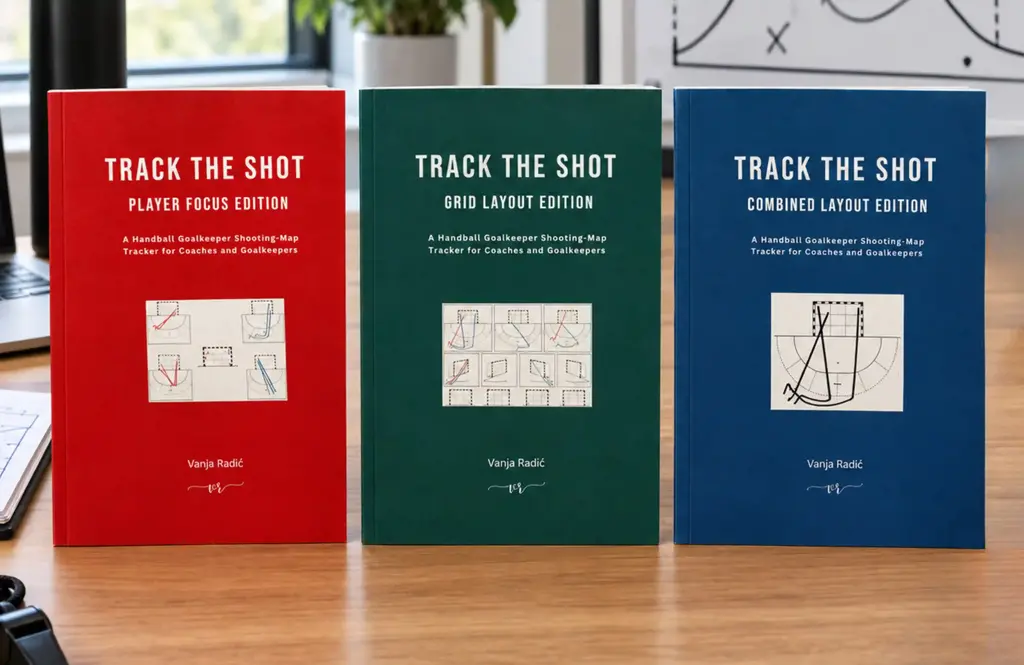
Every edition comes as an A4 paperback or a durable hardcover. In my opinion, the biggest benefit comes from using the tracker every week, because the maps from each video session add up, and after a few months you have a real record of how your opponents shoot. You can see all three editions on my shop page.
Post-Match Analysis: Learning and Growth
Post-match video analysis is just as useful. After the match, goalkeepers and coaches should review the footage together, assess the performance objectively, point out what worked well, and find areas to work on in the next training sessions.
Look at both successful and unsuccessful situations, and try to understand what happened, why the goalkeeper made certain decisions, and how they could handle similar situations next time. Keep the tone constructive and focused on learning, because in my experience, a goalkeeper who feels judged in video sessions stops talking openly about their own decisions.
Performance Improvement Through Objective Feedback: Video review lets goalkeepers look at their own game with an objectivity that is impossible during live action. They can evaluate their positioning decisions, reaction timing, cooperation with the defense, and effectiveness in different game situations.
This self-analysis gives goalkeepers a deeper understanding of their own style and of the areas where there is space to grow. When goalkeepers take an active part in analyzing their performance, they become more self-aware and take more ownership of their development.
Creating Effective Training Applications
Video analysis is most useful when what you find in the footage reaches the training court. Every analysis session should lead to specific drills, positioning guidelines, and tactical preparation that address what you found.
Simulation Training: Use what you learned from video to create training situations that look like the next match. If the analysis shows that the next opponent often uses specific attacking combinations, include drills that recreate these situations as closely as possible.
Technical Focus Areas: When video shows technical elements that need work, plan targeted drills for them. This might include positioning adjustments, footwork patterns, or changes in save technique.
Keep these drills creative and engaging, so goalkeepers can turn what they saw in the footage into actions they trust in the match.
Advanced Analysis Techniques and Modern Tools
Today’s video tools make deeper analysis possible and save a lot of time. Still, technology should serve one simple purpose: helping the goalkeeper prepare and perform better.
Technology in Video Analysis
Modern analysis software lets you break down clips, review them in slow motion, tag situations, and compare different matches.
Online analysis platforms can make the work much faster and give you details that would take hours to collect by hand. In my opinion, the most important part is still the thinking that experienced coaches and goalkeepers bring to the footage, and the software is there to support that thinking.
Collaborative Analysis and Goalkeeper Development
The best video analysis programs involve goalkeepers actively in the analysis, so they help find the conclusions themselves. This develops their analytical skills and makes them more invested in their preparation.
When you teach goalkeepers how to analyze on their own, they become more independent and self-aware, and they can keep learning throughout their careers. It also helps them understand and remember the information better, because patterns a goalkeeper discovers personally stay with them much longer.
Customization and Individual Adaptation
Different goalkeepers respond best to different types and amounts of information. Some like a lot of detail, and others work better with a few simple key points, so a good video analysis program adapts to each goalkeeper’s learning style.
The same is true for presentation. Some goalkeepers respond well to statistics, while others prefer visual presentations or a short story about the opponent. Find the approach that helps each goalkeeper understand and use the information best.
Knowing your goalkeeper’s personality also helps you decide how much information to give and how to present it. Experienced goalkeepers can often handle a detailed analysis, while younger players usually do better with a short analysis focused on a few key elements.
Implementing Video Analysis in Your Coaching
Bringing video analysis into goalkeeper development works best when you plan it systematically and keep your practical limits in mind. The most effective programs start simple and add complexity as coaches and goalkeepers get comfortable with the process.
Building Analysis Skills Gradually
Make video analysis a regular part of your weekly goalkeeper routine, all season long. When it happens every week, coaches and goalkeepers build their analytical skills, and good preparation becomes a habit.
Start with basic analysis of a few key elements, and move on to more detailed breakdowns later. Young goalkeepers especially benefit from learning to recognize patterns step by step, so their analytical skills grow together with their technique. (If you coach young or beginner goalkeepers, my Level 1 and Level 2 Video Courses for Coaches can help you build their technical foundation at the right pace.)
Finding the Balance Between Information and Practice
The challenge is to give enough information to improve preparation without causing analysis paralysis, where a goalkeeper thinks so much that they react too late. Good video analysis finds the balance between thorough preparation and practical use, so the goalkeeper goes into the match confident.
Some goalkeepers do well with detailed information about every opponent tendency, while others perform better with a few key points. Understanding these preferences helps you adapt the analysis to each goalkeeper.
Continuous Improvement and Adaptation
Your video analysis program should keep developing based on feedback and results. Regular evaluation sessions help you see which approaches work best and what you could change.
Keep an eye on new tools and analysis methods as well, since some of them can give you more information or save you time. Keep the process as simple as possible, so the analysis stays useful.
Conclusion: Turning Preparation into Performance
Video analysis brings handball coaching closer to preparation based on evidence, where goalkeepers replace uncertainty with confidence and guesswork with strategy.
The most successful goalkeepers I’ve worked with share one important habit: they know that great saves start long before the ball is shot. Their saves come from thorough preparation, systematic analysis, and the mental readiness that grows from regular video study combined with focused training.
Modern handball asks goalkeepers to combine physical excellence with tactical intelligence. Video analysis gives them the base for this development, and it helps them anticipate the shot, understand their opponents, and approach every match with confidence.
Your challenge this week: If you aren’t using video analysis systematically yet, start with one simple step. Choose one opposing player from your next match and study their shooting tendencies for just 10 minutes. Look for patterns in their approach, their preferred shooting spots, and body language that might reveal their intentions. Mark every shot on a shooting map (a Player Focus tracker works well for this), so the next time you face that player, your notes are already waiting for you.
Small, systematic steps toward better preparation often bring the biggest changes. Every minute you spend studying footage is an investment in your match performance, and it pays back exactly when the pressure is highest and the margins are smallest.
Video analysis covers much more than watching opponents or reviewing technique, because it gives you a systematic way to prepare for every part of goalkeeper development and match performance. When your preparation becomes a weekly habit, you’ll see it in your goalkeeper’s saves.
Stay in Touch
Do you have any coaching challenges you’d like me to address? Let me know what topics you struggle with most in goalkeeper coaching by filling out this form.
Never miss an update
Subscribe to my newsletter to receive updates about my online and in-person projects, research papers, creative projects (blog posts, books, e-books), and new online programs.
My Online Video Courses:
– Level 1 Video Course for Coaches
– Level 2 Video Course for Coaches
– Sliding Technique Video Course
– Agility Ladder Drills Video Collection – 102 drills
Subject to Copyright
Unauthorized use and/or duplication of any content from this website without express written permission from this site’s owner is strictly prohibited. All content (including text, data, graphics files, images, illustrations, videos, and sound files) contained in www.vanjaradic.fi is copyrighted unless otherwise noted and is the property of Vanja Radic Coaching. If you wish to cite or use any content from my website, please contact me first to obtain permission.
No responses yet