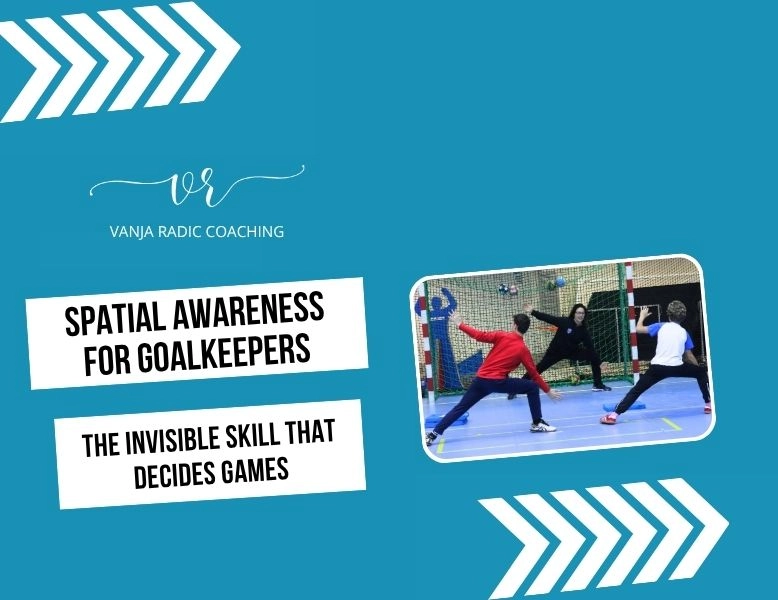
Spatial Awareness for Goalkeepers: The Invisible Skill That Decides Games
There is a moment, half a second long, that separates the goalkeepers who save shots from the ones who react too late. The shooter has not yet released the ball. The ball is still “glued” to their hand. The crowd is loud. The defenders are moving. And somewhere in that chaos, the goalkeeper already knows where the shot is going, where their own feet are, where the post is behind them, and how much space they have to attack and cover. That moment of knowing all of that has a name. It is called spatial awareness, and it’s the invisible skill that decides most games.
I was blessed enough to be able to coach goalkeepers in over 30 countries across 3 continents, from young athletes still learning to read the game to senior national team players preparing for World Championships and Olympic Games. The one thing every elite goalkeeper I have worked with has in common is not their height, their reach, or their reflexes. It’s the way they “read” space. They see the court as a three-dimensional map, and they place themselves on that map without even thinking. The rest of us have to look down, but they already know.
In this post I want to walk you through what spatial awareness actually is, why it matters so much for goalkeepers, what the research says (including studies done specifically on handball goalkeepers), and how I train it with my own goalkeepers. By the end, you will have a clear picture of why this skill deserves a permanent place in your weekly training plan, and several practical ways to start working on it as early as next session.
Key Takeaways
- Spatial awareness is the invisible foundation of every great save. It is the constantly updating internal map that lets a goalkeeper choose where to be before the play fully develops, and it sits underneath every aspect of positioning, anticipation, and decision-making.
- Research on handball goalkeepers gives us clear practical guidance. Eye-tracking studies consistently show that elite goalkeepers fixate on the throwing arm, while novices look at the head. Quiet-eye duration is measurably longer on effective saves. Male and female goalkeepers use different gaze strategies, which has direct implications for individualized training.
- Five building blocks structure the skill. Body schema, egocentric awareness, allocentric awareness, temporal-spatial integration, and peripheral processing each deserve dedicated training attention, woven into every session rather than treated as a standalone topic.
- Mental state protects spatial awareness. Under stress, perception narrows and the spatial picture blurs. Emotional regulation, breathing, and pre-shot routines are part of perceptual training, even though they look like something else.
- Train for game reality, not lab conditions. Research shows perceptual-cognitive training transfers better to real games when it is closer to actual game conditions. Use visual occlusion, full defensive structures, backcourt-specific scenarios, and live decision-making whenever possible.
What Spatial Awareness Really Means for a Goalkeeper
Spatial awareness is the ability to perceive your own body in relation to the objects and people around you, in real time, and to use that information to make good decisions. For a goalkeeper, that definition stretches into something much richer. It includes:
- Knowing where you are in your goal at all times, without checking the posts.
- Understanding the angles the shooter can see from their position.
- Tracking the movement of attackers, defenders, and the ball at the same time.
- Sensing the distance between your hands, your feet, and the ball’s likely trajectory.
- Adjusting your body position in tiny increments so you cover the most dangerous area of the goal.
Most coaches talk about “positioning” as if it were a static thing. You stand here for a wing shot, you stand there for a 6-meter throw, you step out for a breakthrough. Positioning is the surface of the skill. Spatial awareness is what lives underneath it. It is the constantly updating internal model that lets a goalkeeper choose where to stand before the situation even fully develops.
Think of it this way. A goalkeeper with weak spatial awareness arrives at the right position one second too late. A goalkeeper with strong spatial awareness is already there, calm, balanced, ready, because they predicted the geometry of the play before it happened.
Why This Skill Matters More Than Most People Think
In handball, a backcourt shot can reach the goal in around 0.3 to 0.4 seconds. The 7-meter penalty gives even less margin, with shooter and goalkeeper only 7 meters apart and ball speeds high enough that human reaction time alone can’t cover the gap. The numbers are unforgiving. This is why goalkeepers have to rely on anticipation and pre-positioning, and both depend entirely on spatial awareness.
When a goalkeeper reads space well, they buy themselves time. They are not faster in the physical sense. They are faster because they started moving earlier, from a better starting place, toward a more accurate end point. The save looks like a reflex. It is anything but.
There is another reason spatial awareness matters so much. Goalkeepers do not just defend the goal. They communicate with the defense, organize the block, position teammates, and sometimes initiate the counter-attack. All of this requires reading the entire playing area, not just the area directly in front of you. The goalkeepers I respect most are the ones who see the whole picture, all the time. They are coaches on the court while they play.
What the Research Tells Us About Handball Goalkeepers Specifically
Anything that I write, teach, coach, or talk about, I want to know what the research says about that topic. The good news is that the science on handball goalkeeping has grown considerably in the past decade, and the findings are really useful for coaches.
Goalkeepers see the world differently
A 2023 study by Michael Quinn and colleagues at University College Dublin, published in Current Biology, found that professional soccer goalkeepers process sensory information differently from outfield players and from people who don’t play sport at all. The researchers tested what is called the “temporal binding window,” which is the time period in which signals from different senses (vision and hearing, for example) are perceptually fused into one event. Professional goalkeepers had a narrower temporal binding window, meaning they kept visual and auditory signals more separate. You can read a clear summary of the study on ScienceDaily.
Why does this matter? Because goalkeepers constantly receive incomplete information. They see the shooter’s body move, they hear the contact with the ball, they sense the movement of defenders. Those signals arrive at slightly different times. A goalkeeper who can keep them separate, evaluate each one, and combine them only when needed, makes better decisions about where the ball is going and where to be.
Where elite handball goalkeepers actually look
This is where the handball-specific research becomes really interesting. Multiple studies have used mobile eye-tracking technology to record what handball goalkeepers fixate on during real penalty situations, and the findings give us coaching insights you can’t get any other way.
Let me walk you through the most important studies one by one.
The Rivilla-García et al. study (2013): Spanish researchers compared elite and amateur handball goalkeepers using video-based eye-tracking. They found that elite goalkeepers spent significantly more time fixating on the throwing arm of the penalty thrower and on the ball itself, while amateur goalkeepers distributed their gaze less efficiently, often spending more time looking at the head of the shooter. The amateur strategy is exactly what skilled shooters exploit with head and eye fakes. The elite strategy ignores the fakes and reads the arm, which has to produce the actual throw. This study has been cited in almost every handball goalkeeper research paper since, because the finding is so clear and so practical.
The Schorer et al. work on backcourt throws: Joerg Schorer and colleagues have done some of the most useful research on handball goalkeeping anywhere in the world. Their work shows that experienced goalkeepers rely on what researchers call “globally distributed cues” rather than fixating on a single body part. In other words, the best goalkeepers integrate information from multiple sources at once, including the throwing arm, the planting foot, the hip rotation, the shoulder line, and contextual information about the shooter’s tendencies. This is more advanced advice than simply: “watch the arm”, (which we can hear every single goalkeeper coach say to young goalkeepers. It’s closer to: “build a mental model of the whole shooter and the whole situation, with the arm as the anchor point.”
The 2025 Polish study “Differences in Gaze Behavior Between Male and Female Elite Handball Goalkeepers During Penalty Throws”, published in Brain Sciences: This is the most recent and most detailed handball-specific eye-tracking study, conducted by Jedziniak, Panek, Lesiakowski, Florkiewicz, and Zwierko. The full paper is available open-access on PubMed Central. The researchers tested 40 elite handball goalkeepers from the Polish Superliga (20 female, 20 male), with several national team players included. Each goalkeeper faced five real-time penalty throws while wearing a mobile eye-tracking system. The numbers they generated are worth sharing in detail, because they are the kind of data coaches almost never get to see.
The biggest finding was about quiet-eye duration, which is the length of the final fixation before initiating action. Saves that worked had significantly longer quiet-eye durations than saves that did not. Female goalkeepers showed a mean difference of 92.26 milliseconds between effective and ineffective interventions (p = 0.005). Male goalkeepers showed a mean difference of 122.83 milliseconds (p < 0.001). To put this in coaching language, when these elite goalkeepers held their final gaze on the right spot for roughly a tenth of a second longer, they were significantly more likely to save the ball. The save was not built by being faster. It was built by looking longer at the right thing.
The study also found something most people miss completely. Female and male elite handball goalkeepers used measurably different gaze strategies during the penalty throws:
- Male goalkeepers spent significantly more time fixating on the throwing forearm (mean difference of 15.52, p < 0.001), the throwing upper arm (mean difference of 6.83, p < 0.001), and the ball (mean difference of 7.46, p < 0.001).
- Female goalkeepers spent significantly more time fixating on the torso (mean difference of 14.26, p < 0.001) and the head (mean difference of 11.91, p < 0.001) of the throwing player.
The researchers interpreted this as two different but equally valid strategies. The male goalkeepers were tracking moving objects in spatio-temporal areas, essentially watching the arm and ball in motion to predict the throw. The female goalkeepers were observing relatively stable body areas to recall task-specific information from memory, essentially matching what they saw against patterns built up through video study and pre-game preparation. Neither approach was “better.” The save rates were comparable. The paths to the save were just different.
This is a really important nuance, and I want to be careful not to oversimplify it. The older Rivilla-García work tells us that elite goalkeepers (mostly male, in that study) look at the throwing arm more than amateur goalkeepers do. The newer Polish study tells us that among elite goalkeepers, men and women lean on different visual anchors. Both findings can be true at the same time. The training takeaway is that gaze strategy is not one-size-fits-all, and developing goalkeepers benefit from being exposed to multiple visual approaches rather than being forced into a single template.
What about left-handed shooters? There is one more handball-specific finding worth knowing. A study “Accuracy of Outcome Anticipation, But Not Gaze Behavior, Differs Against Left- and Right-Handed Penalties in Team-Handball Goalkeeping” by Loffing and colleagues (available through PubMed Central) found that handball goalkeepers were significantly less accurate at predicting throws from left-handed shooters than from right-handed shooters, even though their gaze patterns looked similar in both cases. The likely explanation is exposure. Most goalkeepers spend most of their training time facing right-handed throwers, simply because there are more of them. The visual system becomes attuned to right-handed kinematics. Against a left-hander, the body cues are mirrored, and the goalkeeper’s mental model has fewer reference points. The coaching implication is straightforward. If your team will face a left-handed shooter, make sure your goalkeeper has trained against left-handed throws repeatedly in the lead-up to that match. The brain needs the exposure.
Why quiet eye matters more than people realize: I want to spend an extra moment on the quiet-eye finding, because I think it is one of the most actionable insights in the entire goalkeeper literature. Quiet eye is essentially the brain saying: “I have selected my target, I am now committing my attention to it, and I am preparing my motor response based on what I see here.” A longer quiet-eye duration is associated with better attentional control, less anxiety, and more accurate motor execution. Research across multiple sports has shown that quiet-eye training (which is a specific kind of perceptual coaching) can improve performance under pressure. For handball goalkeepers, the practical takeaway is that you don’t want your athletes scanning wildly in the final moments before the shot. You want them locking onto their anchor (whether that is the arm, the ball, the torso, or the hip) and holding the gaze long enough to extract real information. Hesitation and over-scanning are the enemies of the save.
How to use all of this in training: First, watch video with your goalkeepers and ask them where they were looking at the moment of decision. Their answers will tell you what kind of visual style they have naturally developed. Second, expose them to multiple approaches. Have them try the throwing-arm anchor, the torso anchor, and the hip anchor, and see which one feels most reliable to them. Third, train the quiet eye directly. You can do this with simple drills where the goalkeeper has to fixate on a specific point for the entire lead-up to the shot, then react. Over time, the longer fixation becomes automatic, and so does the calm, decisive movement that follows it.
Sex differences that matter for training
The same Polish study revealed something most coaches never think about. Female and male elite handball goalkeepers use different gaze strategies. Female goalkeepers tend to observe relatively constant body areas, suggesting they recall task-specific information from memory. Male goalkeepers focus more on moving objects in spatio-temporal areas. Neither approach is “better.” They are different, and the research authors specifically suggest perceptual training programs should be tailored accordingly.
I have noticed this in my own coaching work, even before reading the study. The female goalkeepers I have worked with often build deeper pattern libraries through video study and pre-game preparation, while male goalkeepers I have coached often rely more on in-the-moment tracking. Knowing this changes how you design drills. It also reminds us that “one-size-fits-all” coaching is rarely the best approach.
The backcourt throw problem
Here is something most goalkeeper articles miss completely. The vast majority of perceptual research on goalkeepers has focused on the 7-meter penalty, but in actual handball games, backcourt throws (from 9 meters and beyond) are far more common and arguably more important. A study published in Frontiers in Psychology in 2023, “Expert goalkeepers’ and coaches’ views on anticipation and cue utilization facing backcourt throws in handball goalkeeping”, available through PubMed Central, interviewed expert handball goalkeepers and goalkeeper coaches specifically about backcourt throws. They found that goalkeepers rely on both kinematic cues (the shooter’s body movement, throwing arm position) and contextual cues (the opponent’s preferences, on-court positioning, defensive structure) in ways that are quite different from how they handle penalty situations.
The practical takeaway is simple. If your goalkeeper training program only prepares athletes for clean 1v1 penalty-style situations, you are leaving them unprepared for the most common scoring situations in the game.
A useful piece of honesty about the science
I want to be straight with you about one thing. A 2024 systematic review and meta-analysis published in Healthcare, available through PubMed Central, looked at 22 studies on perceptual-cognitive training in team sports. The results showed strong improvements in lab-based testing (effect size of 1.51), but much smaller improvements in actual game performance (effect size of 0.65). Both effects are real and meaningful, but the gap is important.
What does this mean for coaches? It means that perceptual training works, but it works better when it is closer to game reality. Video clips on a laptop will help. VR simulations are promising and may help a little bit more (early research is encouraging, though the evidence on transfer to real-game performance is still developing!). But the most reliable form of training, based on what we know now, is live practice with real shooters, real defenders, and real game pressure, because it preserves all the perception-action coupling that the brain actually uses in competition.
The Five Building Blocks of Goalkeeper Spatial Awareness
When I work with my goalkeepers, I break spatial awareness down into five pieces. This is how I think about it in training planning, and it helps me decide what to work on in any given week.
1. Body schema (knowing where you are without looking)
Body schema is the brain’s internal map of where your limbs are in space. A goalkeeper who has poor body schema constantly looks down to check their feet, or steps back too far and crashes into the post, or extends a hand to a ball that is already past them. A goalkeeper with strong body schema feels the goal behind them, feels the line under their feet, feels where their hands are without checking.
You can train this. Simple drills like balance and stability work on unstable surfaces, eyes-closed footwork, and proprioception games all contribute. I like to have goalkeepers move along the goal line with their eyes closed and stop when they think they are at the post. The feedback is immediate.
2. Egocentric awareness (where everything is in relation to you)
Egocentric awareness is the picture of the world from your own point of view. It tells you how far the shooter is, where the wing player is creeping in, how close your defender is. For goalkeepers, this is the working memory of the play.
I train this with what I call “moving picture” drills. The goalkeeper has to call out the positions of three or four moving players before reacting to the shot. It forces the brain to keep multiple objects in active spatial memory while still preparing to save.
3. Allocentric awareness (where things are in relation to each other)
This one is harder, and it separates good goalkeepers from great ones. Allocentric awareness is the ability to see the play from above, like a coach watching from the stands. It is not about you. It is about the geometry between attackers, defenders, and the goal.
When a goalkeeper has strong allocentric awareness, they can predict how a play will develop, not just what the next shot will be. They see the pass before it happens because they understand the spatial logic of the situation. Developmental psychology research shows that allocentric coding starts emerging in children between two and a half and three years of age, but in sport, it can be sharpened well into adulthood. Elite goalkeepers continue developing this kind of awareness throughout their careers.
4. Temporal-spatial integration (combining where with when)
Space without time is useless for a goalkeeper. A shot is not just a location, it is a location at a specific moment. Temporal-spatial integration is the ability to merge those two dimensions. The goalkeeper knows that the ball will arrive here in this many milliseconds.
This is where anticipation lives. I have written more about this in my post on handball goalkeeper anticipation, and I would recommend reading it alongside this one, because anticipation and spatial awareness are deeply connected.
5. Peripheral processing (seeing without looking directly)
Goalkeepers can’t afford tunnel vision. The brain has to process information from the edges of the visual field while the eyes stay focused on the central cue (most often the throwing arm or the ball, based on the eye-tracking research). Strong peripheral processing means the goalkeeper notices the wing player breaking in, the pivot turning, the defender stepping out, all while keeping primary focus on the shooter.
This skill is trainable too, and some of the most interesting training tools in modern sports science target exactly this. Specialized vision training boards, light-reaction systems, and even certain virtual reality protocols can sharpen peripheral processing significantly.
Where Your Goalkeeper Should Be Looking: Practical Coaching Notes
Drawing from the research we just walked through, I want to give you a practical summary that you can take into your next training session. Here is how I think about visual anchors with my own goalkeepers.
The throwing arm is a strong default anchor. For developing goalkeepers who don’t yet have a refined gaze strategy, training them to fixate on the throwing arm (specifically the shoulder, upper arm, elbow, and forearm) is a high-value starting point. The arm is biomechanically committed to producing the throw, so it gives more honest information than the head or eyes, which good shooters use for fakes. Rivilla-García’s research showed clearly that elite goalkeepers fixate on the throwing arm more than amateur goalkeepers do, and this is one of the most reliable findings in the literature.
The torso and head can also work, especially for goalkeepers with strong pattern memory. The 2025 Polish study showed that female elite goalkeepers favored the torso and head as primary anchors, and their save rates were comparable to male goalkeepers using the arm-and-ball anchor. The reason this works is that the torso integrates information from the shoulder line, hip rotation, and overall body orientation. For a goalkeeper who has built up a strong library of shooter patterns through video study, the torso can serve as a single visual anchor that draws on memory rather than real-time tracking.
The ball is almost always part of the picture, but rarely the primary anchor in the lead-up. Elite goalkeepers track the ball with peripheral vision while their central gaze stays on the arm or torso. Once the ball is released, the visual system shifts to ball tracking, but by then the save has largely been decided by the pre-release reading of the shooter.
Whatever the anchor, the goal is to hold it longer. The quiet-eye finding from the 2025 study cuts across all of this. Whether your goalkeeper anchors on the arm, the torso, or the ball, the longer they can hold that final fixation calmly and steadily, the more accurate their save tends to be. “Wild” scanning in the final moments before the shot is the enemy of performance.
How to train this in practical sessions: Start by watching video together with your goalkeeper and pausing clips just before ball release. Ask them where they were looking. Their answer will reveal their natural visual style. Then introduce variations. Have them try the throwing-arm anchor for a series of shots, then the torso anchor for another series, then the hip anchor for another. Talk about how each one felt. Most goalkeepers will naturally gravitate toward one approach, and that is fine. The point is that they have chosen consciously, rather than defaulting to looking at the shooter’s face, which is the most common amateur mistake.
You can also use partial-screen drills, where a small piece of cardboard or fabric blocks part of the shooter’s body during practice throws. This forces the goalkeeper to extract information from whatever is visible, which builds flexibility into their gaze strategy. A goalkeeper who can read the arm when the head is blocked, and read the torso when the arm is blocked, is much harder to deceive than one who relies on a single rigid visual habit.
How I Train Spatial Awareness in My Sessions
This is the part most coaches care about most, and I understand why. Theory is useful, but only if it changes what we do on the court. Here are some of the approaches I actually use with my goalkeepers, from youth level to senior national team.
Constraint-based drills
Instead of telling goalkeepers what to do, I change the environment so that they have to figure it out. For example, I might place small cones at specific points on the goal line and tell the goalkeeper they can’t step outside those markers during a sequence of shots. This forces them to find new ways to read shooting angles. Or I will block their view of the shooter at the last moment with a screen, so they have to rely on the cues they picked up earlier.
Constraints make the brain work. They strip away habits and force adaptation. This is how spatial awareness actually grows.
Visual occlusion training
This deserves its own mention because the research support is strong. Visual occlusion means deliberately limiting what the goalkeeper can see, then forcing them to perform anyway. It could mean wearing strobe glasses that flicker on and off, covering one eye briefly, or using a screen that hides the shooter’s body at certain points in the action.
Studies in handball and other sports have shown that goalkeepers who train with visual occlusion develop richer mental models of shooting patterns and faster anticipatory responses. The brain learns to extract more information from less input. When the goalkeeper returns to normal vision, the picture feels easier and clearer. I have written about how I use this in detail in my post on visual occlusion in handball, which has practical drill ideas you can use right away.
Multi-ball and chaos drills
Goalkeepers need to learn to process more than one threat at a time. I run drills where two or three shooters can release a ball at any moment, and the goalkeeper has to keep all of them in their spatial map. Only one will actually shoot, but the goalkeeper doesn’t know which one until the last fraction of a second.
These drills are exhausting in a way that pure shot-saving drills are not. The fatigue is mental. That is the point. Mental fatigue is the doorway to mental growth.
Backcourt-specific training
Because the research is clear that backcourt throws are under-studied and under-trained compared to penalties, I make sure my goalkeepers face plenty of realistic backcourt scenarios. This means working with a full defensive structure in front of them, not just a clean shooter alone with the ball. The defense matters. It blocks the view, changes the angles, and forces the goalkeeper to read partial information, which is exactly what happens in real games.
If your goalkeeper only ever sees clean shooting situations in training, they will struggle the first time a defender drops in front of them mid-game. Train for the mess. The mess is the game. 🙂
Video analysis with spatial focus
Most goalkeeper video analysis focuses on technique. Did the goalkeeper move the right hand? Was the leg in the right position? I do that too, but I always add a layer of spatial analysis. Where was the goalkeeper standing in relation to the post? How much of the goal was open from the shooter’s perspective? Did the goalkeeper see the second attacker?
I use slow-motion replay and freeze frames to ask the goalkeeper what they were looking at. Their answers reveal so much about their internal spatial model. Often, the technical mistake was actually a perceptual mistake. They were not in the wrong place because they moved badly. They were in the wrong place because they read the situation wrong.
Cognitive load training
When you add a cognitive task on top of a physical task, you teach the goalkeeper to maintain spatial awareness under pressure. Counting backwards while doing footwork. Solving a math problem between shots. Calling out colors that a coach holds up while making a save. The brain learns to handle distraction without losing the spatial picture.
For a deeper look at this whole topic, the research from labs like the Cognitive Neuroscience Society and applied sport psychology centers is worth your time. Real cognitive training in sport is a serious field, and goalkeepers benefit from it more than almost any other position.
The Mental Side of Spatial Awareness
I can’t talk about spatial awareness without talking about the mental side, because the two are inseparable. A goalkeeper under emotional pressure loses spatial awareness first. Anxiety narrows vision. Frustration shrinks the perceptual field. Fear of mistakes makes the goalkeeper freeze, and a frozen goalkeeper sees less.
There is even research backing this up. A 2024 study on youth athletes published in Frontiers in Psychology found that emotional state directly influences spatial perception, with negative emotional states reducing perceptual accuracy and response speed. The relationship between emotion and perception is not just theory. It is measurable, and it shows up in real performance.
I have watched goalkeepers who were spatially brilliant in training fall apart in big games, not because their skill disappeared, but because their nervous system stopped letting them access it. The picture they could see in calm conditions became blurry under stress.
This is why I spend so much time on the mental side of goalkeeping. Breathing protocols, pre-shot routines, self-talk patterns, emotional regulation work. These are not extras. They protect the spatial awareness you spent years building.
The shooter wants to take away your time and your space. The goalkeeper’s job is to protect both. That protection starts in the mind.
Common Mistakes Coaches Make When Training Spatial Awareness
Mistake one: Only training spatial awareness through repetition. Doing the same drill a thousand times does not build perception. It builds habits. Habits are useful, but they are not the same as awareness. Real perceptual learning needs variability, novelty, and challenge.
Mistake two: Treating spatial awareness as a separate skill block. I see coaches who do “spatial awareness day” once a month (maybe), and the rest of the month is pure technique. This makes no sense. Spatial awareness lives inside every action a goalkeeper takes. It should be present in every practice, in every drill, in every conversation, in every video session.
Mistake three: Ignoring individual differences. Some goalkeepers naturally lean on visual cues, others on auditory cues, others on bodily feedback. The eye-tracking research even shows differences between male and female elite goalkeepers in their gaze strategies. A good coach finds out what their goalkeeper’s dominant style is and trains both the strength and the weakness. A one-size-fits-all approach leaves performance on the table.
Mistake four: Forgetting that fatigue destroys spatial awareness. When a goalkeeper is exhausted, the first skill to go is perception. Their reading of the game becomes slower, narrower, more reactive. This is why physical conditioning is part of perceptual training, even though it doesn’t look like it.
Mistake five: Coaching from the outside without checking the inside. The goalkeeper’s experience of the situation is not the same as what the coach sees from the sideline. I always ask my goalkeepers what they perceived, what they expected, what they felt. Their answers shape my next coaching intervention. Without that conversation, I am just guessing.
Mistake six: Only training penalty-style situations. The research is clear that backcourt throws are one of the most frequent scoring situations in handball, but they are the least studied and often the least trained. Make sure your goalkeepers face full defensive structures with realistic timing and visibility challenges, not just clean 1v1s.
A Challenge for You This Week
Pick one drill you already run regularly with your goalkeepers. Maybe it is a simple shooting drill, or a footwork pattern, or a 1v1 sequence. Now add one small constraint that challenges spatial awareness. Cover one eye for a few repetitions. Add a second moving attacker. Block the goalkeeper’s view of the shooter at the last second. Change the angle every time.
Then, after the session, sit with your goalkeeper and ask three questions: “What did you see? What were you looking at? What surprised you?” Their answers will teach you more about their perception than any video clip ever could! 🙂 And you will start to see the invisible skill that has been quietly deciding games all along.
Goalkeeping is an amazing position. It rewards intelligence, courage, and patience. Spatial awareness is the thread that ties all three together. Train it well, and you will give your goalkeepers a kind of confidence that does not come from saves alone. It comes from knowing, at every moment, exactly where they are, where the ball is going, and what they need to do next.
That kind of knowing is rare. And it is worth the work it takes to build it.
Stay in Touch
Do you have any coaching challenges you’d like me to address? Let me know what topics you struggle with most in goalkeeper coaching by filling out this form.
Never miss an update
Subscribe to my newsletter to receive updates about my online and in-person projects, research papers, creative projects (blog posts, books, e-books), and new online programs.
My Online Video Courses:
– Level 1 Video Course for Coaches
– Level 2 Video Course for Coaches
– Sliding Technique Video Course
– Agility Ladder Drills Video Collection – 102 drills
Subject to Copyright
Unauthorized use and/or duplication of any content from this website without express written permission from this site’s owner is strictly prohibited. All content (including text, data, graphics files, images, illustrations, videos, and sound files) contained in www.vanjaradic.fi is copyrighted unless otherwise noted and is the property of Vanja Radic Coaching. If you wish to cite or use any content from my website, please contact me first to obtain permission.
No responses yet