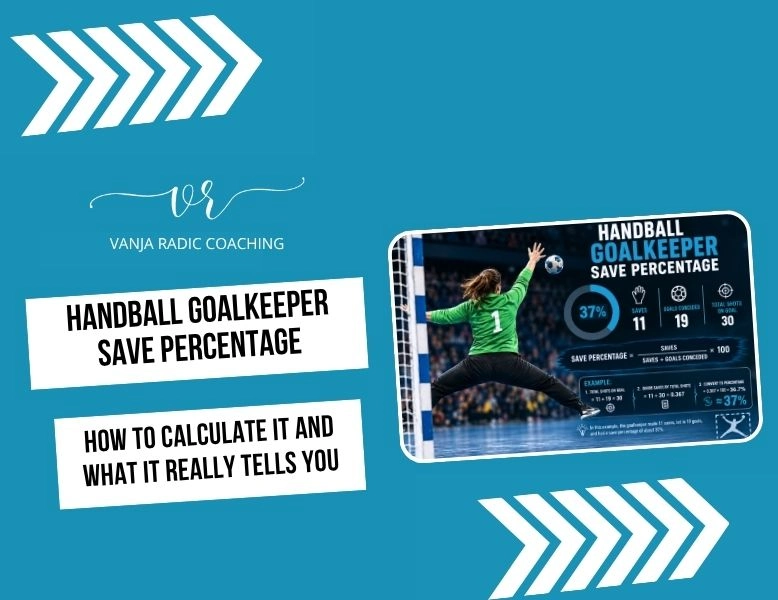
Handball Goalkeeper Save Percentage: How to Calculate It and What It Really Tells You
Every handball goalkeeper gets judged by one number more than any other, and that number is their save percentage. Coaches look at it, goalkeepers compare it, and scouts use it to decide goalkeeper’s level of performance. Handball goalkeeper save percentage is the share of shots on goal that a goalkeeper saves, and it’s at the center of how the goalkeeper position is measured. In this post, I’ll explain exactly what it means, how to calculate it step by step, what counts as a “good” number in handball goalkeeping, and what it actually tells you about a goalkeeper. I’ll also show you where this number can fool you, because reading it without context is one of the most common mistakes I see some coaches make.
I’ve spent years watching goalkeepers, tracking their shots, and helping coaches make sense of the numbers. A single percentage can teach you a lot about a goalkeeper, and it can also mislead you badly if you read it on its own. My goal here is to give you both sides, so you walk away able to use this number wisely.
Key Takeaways
- Save percentage is number of goalkeeper saves divided by total shots on goal. Count the saves and the goals conceded, add them for total shots on goal, and divide the saves by that total.
- Around 30 percent of saves is average at elite level, and 40 percent or more is world class. Handball save percentages are far below other sports, because handball is a high-scoring game with close-range shots.
- Shot type changes everything. Back-court shots are saved around 40 percent, while first-wave fastbreaks are around 23 percent, so breaking the number down by shot type tells you far more than the overall figure.
- Context decides what the number means. The quality of defense in front of a goalkeeper, the number of fastbreaks a team concedes, and the sample size all shape a save percentage, so a raw number can hide a great performance or flatter a poor one.
- Tracked data beats memory. Recording every shot by zone lets you calculate a real, useful save percentage and shows you exactly what to work on in training.
What Save Percentage Actually Is
Save percentage is the share of shots on goal that a goalkeeper saves. If a goalkeeper faces shots that are on target (the goal), their save percentage tells you how many of those they saved, blocked, written as a percentage. For example, a goalkeeper with a 35 percent save rate stopped 35 out of every 100 shots on goal they faced.
The save percentage number is important because goalkeeping is at the center of a handball result. Research on elite tournaments has found a link between goalkeeper save statistics and where teams finish, so a team with a higher save percentage tends to place higher in the standings. That connection is why this number so much weight in how the position is judged, and why handball goalkeeper save percentage is worth understanding properly rather than just briefly.
You’ll see handball goalkeeper save percentage reported in a few ways. After a single game, it captures how a goalkeeper did against shots on that game. Across a tournament or a season, it becomes a running total of all their saves against all the shots on goal they faced, which gives a more complete measure of their level. Match programs, federation websites, and live-score apps all show it, usually next to the save count, because it puts every goalkeeper on the same scale regardless of how many shots they faced. A goalkeeper who made 8 saves and one who made 15 can be compared fairly once you see what share of their shots each one stopped.
How to Calculate Handball Goalkeeper Save Percentage
The formula is simple. You divide the number of saves by the total number of shots on goal, then turn it into a percentage.
Save percentage = saves ÷ (saves + goals conceded) × 100
Here’s an example: a goalkeeper plays a match, makes 11 saves, and lets in 19 goals. The total shots on goal add up to 11 saves plus 19 goals, which is 30 shots. Divide 11 by 30, and you get 0.367, which is a save percentage of about 37 %. That’s a strong game at a high level.
The key to getting this right is counting the right shots. Handball goalkeeper save percentage uses shots on goal, which means saves plus goals. Shots that a goalkeeper faces and saves, and shots that are scored goals, both count. This gives you a clean measure of what the goalkeeper did with the shots that actually reached the goal.
What Counts as a Shot on Goal
Not every attempt a team makes counts toward a goalkeeper’s save percentage, and knowing what to include keeps your numbers accurate.
Shots blocked by the field defenders in front of the goalkeeper don’t count, because the goalkeeper never had a chance to make a play on them. Shots that miss the goal, going wide, over the bar, or hitting the post, also don’t count, since they never reached the goalkeeper as a save to be made. The goalkeeper’s save percentage relies only on the shots that were on target: the ones they saved and the ones that became goals.
7-meter penalties are their own case. Official statistics often track them separately, and many full-match totals also fold them into the overall save percentage, because a penalty is a very different situation from open play. When you calculate handball goalkeeper save percentage, decide up front whether you’re including 7-meter shots, and stay consistent, so your numbers compare equally from game to game.
You calculate a save percentage for any part of the game the same way. If, for example, you want a goalkeeper’s back-court save percentage. Count only the 9-meter shots on goal they faced, divide their 9-meter saves by that total, and turn it into a percentage. A goalkeeper who saved 7 of 16 back-court shots has a back-court save percentage of about 44 %, even if their overall number for the match was lower. Calculating handball goalkeeper save percentage by zone like this is where the actual goalkeeper coaching value lives, because it shows you where a goalkeeper wins and where they lose goals.
What Counts as a Good Save Percentage in Handball
Save percentages in handball are much lower than the numbers people know from ice hockey or football, and that surprises newcomers to our sport. Handball is a high-scoring sport, with players shooting from close range at high speed, so even the best goalkeepers in the world sometimes let in many goals. A save percentage that would look poor in another sport is often excellent in handball.
The reason handball numbers are so low comes down to the game itself. Players shoot from 6 to 9 meters at speeds that can pass 100 kilometers per hour, they jump and change angle in the air, and the game moves fast with many shots per match. A goalkeeper faces a stream of high-quality chances that a goalkeeper in a lower-scoring sport rarely sees. The IHF’s technical analysis of recent World Championships puts the top teams’ goalkeeper effectiveness in the mid-30s, after a low point around 2019 to 2021 that has since recovered. Against that backdrop, a goalkeeper who reaches 40% over a tournament has done something remarkable.
Here are realistic reference points from elite competition, drawn from the IHF’s technical analysis of recent World Championships:
- Low-to-mid 30% is the benchmark for the best teams. At the 2025 men’s World Championship, the eight best teams averaged a goalkeeper saving effectiveness of 33.9%, and across the last three World Championships this figure has settled in the mid-30s %.
- High 30% marks a tournament-leading team. At that same 2025 men’s event, Denmark’s goalkeepers led with 39.8%, ahead of Germany at 38.1% and Brazil at 36.8%.
- Low-to-mid 40% is the mark of a standout individual. At the 2025 women’s World Championship, Norway’s goalkeepers reached 46.9%, with Katrine Lunde posting 86 saves at a 47.8% save rate in her final World Championship. Among the men, Emil Nielsen of Denmark led the 2025 World Championship at 43% over nine matches.
- Around 30% is closer to the full-field average once you include the weaker teams. At the 2025 men’s junior World Championship, overall goalkeeper effectiveness sat at 30.1%, and senior teams from outside Europe often run about 10% below the top teams.
Youth and lower levels vary more widely, so as a friendly coaching tip: I’d always build your own local reference points rather than judging a young goalkeeper against a senior international number.
Why Save Percentage by Shot Type Matters
A single overall number hides a lot, and breaking handball goalkeeper save percentage down by shot type is where it becomes genuinely useful for goalkeeper coaching. Different shots are saved at very different rates, and understanding that changes how you read a goalkeeper’s numbers.
Back-court shots, taken from 9-meters or further, get saved at the highest rate, because the goalkeeper has a fraction more time to read the shooter and set their position. At the 2025 Men’s World Championship, the leading teams saved close to half or more of their 9-meter shots (Denmark 55.9%, Croatia 47.4%, Germany 46.2%), and the top women’s teams saved above 50%.
Close-range and open shots run the other way. Shots from 6-meters, from wing angles, from breakthroughs, and especially from fastbreaks are saved at much lower rates, because the shooter comes with speed, a close angle, and often with less help from defense in the way. The faster and closer the shot comes from, the less the goalkeeper has to work with.
The part of the goal matters too. Goalkeepers save the highest share of shots aimed at the central and middle areas of the goal, while the corners are far harder to reach. The upper corners are the toughest of all. A goalkeeper who saves a high corner shot has done something special, and a goalkeeper beaten there has conceded a shot that beats almost everyone.
Here are the figures the top teams posted at the 2025 Men’s World Championship, from the IHF’s analysis:
- 9-meter (back-court) shots: the highest-save zone, with the best teams between 46 and 56%, since the goalkeeper has a moment more to read and position.
- Wing shots: saved at a moderate rate, with the best teams from 35 to 41%, helped by the tight angle the wing has to score through.
- 6-meter shots: harder to save, taken from close range, with the best teams around 29 to 33%.
- Breakthroughs: lower again, with the best teams between about 27 and 37%.
- Fastbreaks: the hardest open shots to stop, saved at around 20% (the EHF EURO 2022 analysis put first-wave fastbreaks near 23%), because of speed, space, and a close angle.
- 7-meter penalties: a category of their own, a duel between shooter and goalkeeper, tracked separately by many coaches.
You can read these numbers as an international elite benchmark, taken from the top eight teams at a World Championship, rather than fixed targets. Different leagues, countries, and levels differ. Men’s and women’s handball follow the same overall pattern, with the top teams in both saving over half of their 9-meter shots and struggling most with fast, open shots.
What the Latest World Championships Show
The clearest, most current picture comes from the IHF’s technical analysis of the 2025 World Championships, and a few patterns stand out.
Goalkeeper effectiveness has recovered. After a low point around 2019 to 2021, the top teams’ saving effectiveness has climbed back into the mid-30% and settled there across the last three World Championships. At the 2025 men’s event, the eight best teams averaged 33.9%, with about 13.5 saves per match.
Long-range saving has improved, while open shots stay hard. The IHF analysts point out that goalkeepers have become better at saving 9-meter shots, with the top teams now saving more than half of them. Modern high-speed handball puts goalkeepers in more one-on-one situations against open shooters from close range and on the break, and those are the hardest shots to save. Goalkeepers are adapting, using feints and constant movement to challenge shooters in these moments.
The very best stand far above the average. Norway’s goalkeeping at the 2025 women’s World Championship, led by Katrine Lunde at amazing 47.8%, was a main reason for the gap between Norway and the rest of the field. A single elite goalkeeper can lift a whole team’s numbers, which is part of why the position carries so much weight.
What Save Percentage Tells You About a Goalkeeper
A save percentage read carefully shows you actual things about a goalkeeper. It reflects their shot-saving, their positioning, their reading of the game, and their consistency across a match or a season. A goalkeeper who reads shooters well, sets their feet in the right place, and stays calm under pressure tends to save more shots that reach the goal, and that shows up in the number over time.
The most reliable signal comes from a big sample. One match can swing on a few shots, a hot streak, or a run of easy chances, so a single-game save percentage tells you little on its own. Across a season, or across a full tournament, the number settles and starts to reflect the goalkeeper’s actual level. This is why I always look at handball goalkeeper save percentage over many games before I draw any strong conclusion about a goalkeeper, and this is why I treat one brilliant or one poor match as a small piece of a much bigger picture. Also, as I already mentioned – it’s very important to see and consider what kind of shots our goalkeeper saved, or didn’t save.
Save Percentage Alongside Other Goalkeeper Numbers
Save percentage works best next to a few other numbers, and reading them together gives a fuller picture of a goalkeeper. The save count tells you the workload a goalkeeper carried, so 15 saves at 30% reflects a busy night against many shots, while 8 saves at 40% reflects a calmer game where the goalkeeper was efficient. Saves per game across a season shows how much a goalkeeper is asked to do. Goals conceded are on the other side of the same coin, shaped heavily by the team in front of the goalkeeper. 7-meter save percentage, tracked on its own, tells you how a goalkeeper handles penalties, which is a separate skill from open play. Reading handball goalkeeper save percentage together with these numbers keeps you from leaning too hard on any single figure.
The Limits: Why Save Percentage Can Mislead
Looking only at save percentage (as a measure of goalkeeper’s performance) has its limitations, and reading it without context leads coaches to wrong conclusions. The biggest mistake is that every shot gets counted as equal, when in reality, some shots are far harder to save than others.
Imagine two goalkeepers with the same 30% save rate. One plays behind a very strong, aligned defense that forces opponents into well-defended 9-meter shots, which are much easier to save. The other goalkeeper plays behind a weak defense that receives a lot of fastbreaks and open breakthroughs, which are very hard to save. The second goalkeeper faced a much harder set of shots for the same result, so their performance was actually better. Elite analysts point this out often: a goalkeeper’s raw save percentage can look average while their real work was outstanding, simply because of the shots their defense allowed. The defense in front of a goalkeeper shapes their save percentage number as much as their own skill does.
This is where the type of goal matters as much as the number of goals. A goal that comes from a defensive mistake, or from a fastbreak after your own team lost the ball in attack, is far outside the goalkeeper’s control. The opponent picks up the loose ball, runs, and scores against a goalkeeper who has no defense in front of them and almost no time to react. Saving that type of open shot is a real achievement, and it’s much harder than saving a shot from a calm, organized attack where the defense is set. Two goalkeepers can concede the same number of goals, and the one who faced more of these open, broken situations did the harder job.
This is why the best analysts in handball now look at the quality of the shots a goalkeeper faced, not the raw count alone. They compare a goalkeeper’s saves against how often an average goalkeeper would stop the same shots from the same positions, which rewards goalkeepers who face harder chances. You don’t need advanced software to use the same idea. Simply noting how many fastbreaks and open breakthroughs a goalkeeper faced tells you whether a modest handball goalkeeper save percentage came against a brutal set of shots or an easy one.
Sample size is the other challenge. A goalkeeper can post a 50 percent save rate over one half against a handful of shots, and that number means almost nothing. The fastbreak count matters too, since a team that concedes many fastbreaks will drag its goalkeeper’s percentage down through no fault of the goalkeeper. All of this connects to a wider point I make often about judging athletes by outcomes, which I cover in my post on process goals for athletes: the final number is shaped by many things outside the athlete’s control, so coaching the controllable actions matters more than chasing the outcome figure.
How to Use Save Percentage as a Coach
Save percentage becomes a strong coaching tool the moment you add context to it. A few habits turn it from a blunt scoreboard number into something that guides you towards actual development.
Track it over time rather than game to game, so you see the trend. Break it down by shot type and by goal zone, so you learn where a goalkeeper is strong and where they lose goals, which tells you exactly what to work on in training. Read it alongside the quality of the defense, so you judge the goalkeeper on the shots they actually faced. And with young goalkeepers, use the number to guide development rather than to label them, since a developing goalkeeper’s percentage swings widely and says little about their long-term ceiling. The reading of the game that lifts a save percentage takes years to build, and it grows fastest with good coaching, a theme I return to across my work on goalkeeper development.
Save Percentage for Young and Developing Goalkeepers
Young goalkeepers need extra attention with this number, for a reason that surprises many coaches: young goalkeepers usually have much higher save percentages than senior ones. The shots they face are slower and less skilled, so more of them get saved. As players grow and their shooting gets stronger, faster, and smarter, the same goalkeeper’s save percentage naturally comes down. This pattern is known in handball goalkeeping, and you can see it in the classic training-methodology curve, where the saving percentage sits high in the youngest age groups and comes downward through the teenage years, while the shooters’ scoring percentage climbs higher.
This impacts how you should read a young goalkeeper. A high save percentage at eleven or twelve years old reflects the level of the shooters as much as the talent of the goalkeeper, so it doesn’t promise a great senior goalkeeper. A save percentage that drops as a goalkeeper moves up to stronger competition is normal and expected, part of facing better shooters. I use the save percentage number with young goalkeepers to spot patterns and guide training, and I keep it far away from any label about how good they are or will become. A young goalkeeper who reads the game a little better each month is on the right path, whatever the save percentage says this week.
Studying the Opponent’s Shooting Patterns
One of the best ways to lift a goalkeeper’s save percentage is to prepare them for the shooters they’re about to face. When you know where an opponent’s shooters like to shoot from, and which corners they aim for, you can get your goalkeeper ready for what’s coming, and a prepared goalkeeper saves more.
I’ve made three shot-tracking books built for exactly this. They give you a simple, paper-based way to record an opponent’s shooting patterns, game after game: you can draw where each shooter takes their shots from, and where in the goal they place them. Studied properly across a few matches, those patterns become good preparation you can give to your goalkeeper before you play that team again, which gives them a chance at a higher save percentage in the next match.
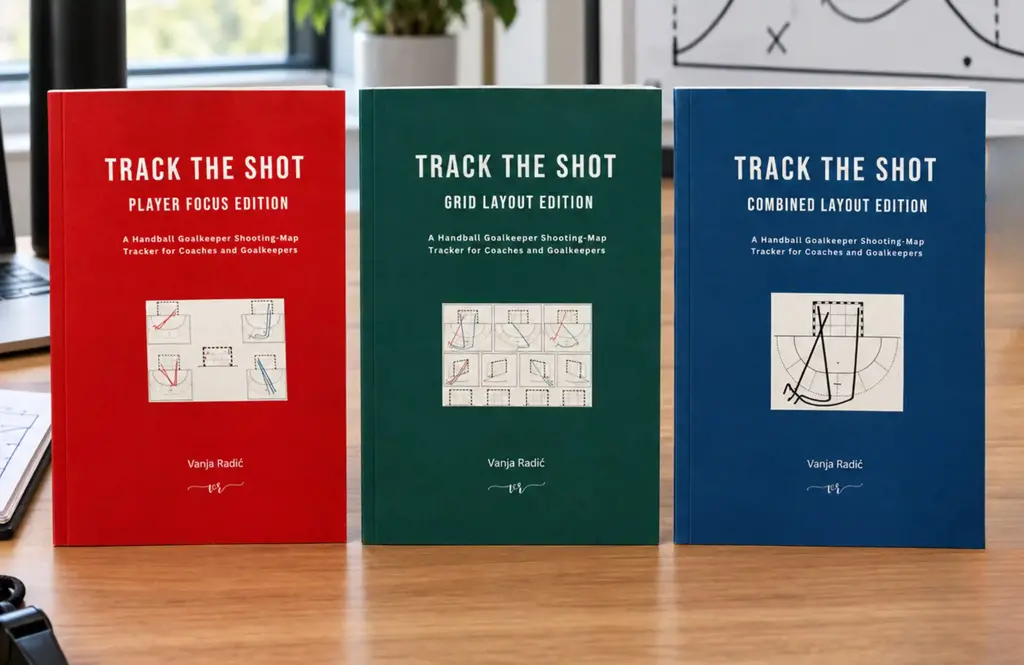
Track the Shot trackers are available for purchase on Amazon, and you can order them here.
Common Questions About Save Percentage
Does a 7-meter count in save percentage? Most full-match totals include it, and many goalkeeper coaches also track it separately, since a penalty is a very different situation from open play. You can decide your approach and stay consistent.
What’s a good save percentage for a youth goalkeeper? There’s no single number, because youth levels vary so much. You can build your own local reference points by tracking your goalkeepers over a season, and read the trend rather than one figure.
Can a goalkeeper have a low save percentage and still be excellent? Yes. A goalkeeper behind a defense that receives many fastbreaks and open shots faces a harder set of chances, so their handball goalkeeper save percentage can look modest while their real performance is strong.
A Challenge for Your Next Match
Track your goalkeeper’s performance in one full match by hand this week. For every shot on goal, note where it came from, whether it was a back-court shot, a wing, a fastbreak, or a 7-meter, and whether your goalkeeper saved it. Then work out their save percentage overall, and again for each shot type. You’ll learn more about your goalkeeper from that one tracked game than from a whole season of watching at the final score.
Handball goalkeeper save percentage is a powerful number when you understand what is behind it. It rewards good reading, good positioning, and good coaching, and it shifts with the defense, the shot types, and plain luck across a small sample. If you read it with context, track it by zone, and use it to guide your training plan, it can become one of the most useful tools you have for developing a goalkeeper. Read it on its own, and it can send you the wrong way. The choice of how to use it is yours, and at least now you have the information you need to use it well. 😊
Stay in Touch
Do you have any coaching challenges you’d like me to address? Let me know what topics you struggle with most in goalkeeper coaching by filling out this form.
Never miss an update
Subscribe to my newsletter to receive updates about my online and in-person projects, research papers, creative projects (blog posts, books, e-books), and new online programs.
My Online Video Courses:
– Level 1 Video Course for Coaches
– Level 2 Video Course for Coaches
– Sliding Technique Video Course
– Agility Ladder Drills Video Collection – 102 drills
Subject to Copyright
Unauthorized use and/or duplication of any content from this website without express written permission from this site’s owner is strictly prohibited. All content (including text, data, graphics files, images, illustrations, videos, and sound files) contained in www.vanjaradic.fi is copyrighted unless otherwise noted and is the property of Vanja Radic Coaching. If you wish to cite or use any content from my website, please contact me first to obtain permission.
No responses yet