Emotion Regulation in Sports: The Skill Nobody Taught Us But Everyone Needs
Sport is all about intense emotions, right? 🙂 In the coaching world, we love to see athletes with “inner fire”, and many of my colleagues actually prefer to see that fire expressed outwards. Strongly. Which sometimes ends up well, and sometimes not so well. Emotion regulation in sports is one of the most important skills for both athletes and coaches, yet it’s rarely discussed openly and almost never trained systematically.
My cultural and handball background comes from a country where it’s highly appreciated to have such a strong desire to play and give your best that it feels like you could literally leave your entire heart on the court. You’re expected to give your very best in every moment, and to show in each moment how much every successful and every less successful move means to you. Which again, sometimes can end up well, and sometimes not so well.
I started paying bigger attention to this aspect many years ago, when I realized that besides being a goalkeeper coach, very often I was also supposed to be a friend, a psychologist, a shoulder to cry on, a mental support, or simply a pair of ears that would just listen to anything my athletes had to say. The emotional dimension of coaching turned out to be far larger than I had anticipated when I started this work.
Key Takeaways
- Emotion regulation is not about eliminating feelings or becoming emotionless. It’s about developing the capacity to experience emotions fully while choosing how to respond, creating space between feeling and acting where thoughtful choice becomes possible.
- Poor emotion regulation destroys performance through multiple mechanisms: attention hijacking, decision-making deterioration, physical tension, confidence erosion, and relationship damage. These effects compound over time if not addressed.
- Both extremes of the emotional spectrum create problems. Explosive emotional expression and complete emotional suppression are both signs of regulation difficulty. Healthy regulation lies in the middle, where emotions are experienced and expressed constructively.
- Coaches model emotion regulation for athletes whether they intend to or not. Athletes watch how coaches respond to difficult moments and learn from that modeling. Improving coach regulation automatically improves the learning environment for athletes.
- These skills are learnable at any age through specific practices: developing emotional vocabulary, creating reset routines, using breathing as an anchor, practicing in training, and building self-compassion. The investment pays dividends in performance and in life beyond sport.
The Story That Changed How I See This
Years ago, a very skilled, hard-working, and promising young goalkeeper told me something I’ve never forgotten: “I am my biggest enemy. I know that. But I just have no idea what to do during the game when I make some unnecessary mistake. I feel like I could kick the goal post until my leg goes numb! I get so angry with myself. I hate myself!”
I don’t know about you, but I have a very big challenge with the word “hate” and the energy behind it. That poor boy was almost purple in his face while explaining his problem, and I felt so much for his inability to process his own emotions. He wasn’t lacking talent, or work ethic. He was drowning in feelings he had no tools to manage.
That conversation was a turning point for me. I realized that emotion regulation in sports is not a nice extra thing. It’s actually very fundamental. Without it, talent gets wasted, hard work gets undermined, and young athletes end up in psychological distress that has nothing to do with their actual ability.
And this wasn’t a unique or rare case. The majority of young athletes I’ve worked with over the past 15 years have had significant challenges with regulating their emotions. Which actually makes complete sense when you think deeply about it.
Why Is This So Common?
How many of us grew up in homes where we were modeled healthy emotional regulation skills? How many of us know what exactly that means, so that we can teach our children or our athletes better ways to deal with something that is inevitable in every sport, and also in everyday life: intense emotions?
The answer, for most of us, is: not many. We weren’t taught this. Our parents probably weren’t taught it either. The adults in our lives did the best they could with the tools they had, but emotional regulation wasn’t part of most childhoods. We learned to suppress emotions, or we learned to explode with them, or we learned some chaotic mix of both depending on the situation.
Then we enter sports, where emotions are amplified. The stakes feel higher. The visibility is greater. The feedback is immediate and often public. And we’re expected to perform while experiencing feelings that nobody ever taught us how to handle.
Emotion regulation in sports is challenging because sports are designed to create emotional intensity. Competition generates excitement, anxiety, frustration, joy, disappointment, anger, pride, shame. These feelings arise automatically. What we do with them is where emotion regulation comes in.
The Two Ends of the Emotional Spectrum
In my work, I’ve observed that athletes and coaches tend to fall somewhere on a spectrum when it comes to emotional expression, and both extremes create problems.
The Explosive End
Sometimes you’ll see emotionally very intense players and goalkeepers, so much so that they’re unable to control their emotions at all. After every single mistake, they seem to get lost and distracted inside their own “emotional tornado”. The anger or frustration takes over completely, and their performance suffers as a direct result.
These athletes often display visible signs of their distress: throwing equipment, hitting themselves, yelling, cursing, dramatic body language. The emotion becomes a show that everyone witnesses. And while that emotion might feel like evidence of how much they care, it actually interferes with the very performance they care about.
The same pattern appears in coaches. How often have you witnessed a very angry coach? Or a coach kicking chairs or the bench during matches or timeouts? How many times have you noticed yourself going completely off the rails over things during your team’s game? How many times are you aware that you’re losing it, even though you know you shouldn’t, even though you know it’s not helping?
The explosive pattern feels powerful in the moment. It feels like you’re doing something with all that energy. But it rarely produces positive outcomes, and it often creates additional problems: damaged relationships, poor decision-making, and modeled behavior that athletes will copy.
The Suppressed End
On the other end of the emotional spectrum, you’ll find extremely “closed” players who seem unable to express basically anything. You’ll have hard times discovering what’s happening behind the emotional wall they’ve built.
These athletes appear calm on the surface, but the calm is actually disconnection. They’ve learned to push emotions down so far that they can’t access them at all. This might seem preferable to the explosive pattern, but it creates its own problems.
Suppressed athletes often struggle with motivation because they can’t feel the positive emotions either. They may appear flat, disengaged, or robotic. Under extreme pressure, the suppression can fail catastrophically, releasing emotions that have been building without outlet. And they miss the useful information that emotions provide about what matters, what’s working, and what needs attention.
The Common Challenge
In both cases, the challenge is the same: the lack of emotional regulation skills. Whether emotions explode outward or get pushed deep inside, the underlying issue is not knowing how to work with emotional experience in healthy, constructive ways.
Emotion regulation in sports is not about eliminating feelings or pretending they don’t exist. It’s about developing a different relationship with emotional experience, one where you can feel intensely without being controlled by that intensity.
What Emotion Regulation Actually Means
Let me clarify what we’re talking about because there’s often confusion around this concept.
Emotion regulation is not emotion suppression. It’s not about becoming emotionless or pretending you don’t feel things. Athletes who try to suppress emotions often end up with the problems I described above: either the suppression fails under pressure, or they lose access to the useful aspects of emotional experience.
Emotion regulation is not emotion expression without limits either. Just because you feel something intensely doesn’t mean acting on that feeling is helpful or appropriate. Feeling angry doesn’t require throwing things. Feeling frustrated doesn’t require yelling at teammates.
Emotion regulation is the ability to experience emotions fully while choosing how to respond to them. It’s the space between feeling and acting. It’s the capacity to notice what you’re experiencing, allow it to be there, and then decide what response actually serves you in this moment.
This is a skill. It can be learned, and it can be practiced. And it can be developed at any age, though earlier is better because patterns become more ingrained over time.
Why Poor Emotion Regulation Destroys Performance
The connection between emotion regulation and athletic performance is direct and powerful. Let me explain the mechanisms.
Attention Gets Hijacked
When emotions overwhelm, they capture attention completely. The athlete who just made a mistake and is now exploding internally isn’t paying attention to what’s happening in the game. They’re paying attention to their own emotional storm.
This attention hijacking means they miss important information. They’re not reading the game. They’re not processing what’s happening around them. They’re trapped in their own experience while the competition continues without them.
In positions like goalkeeping, where constant vigilance and fast reactions are essential, this attention hijacking can be catastrophic. The goalkeeper lost in emotional turmoil after one goal is poorly positioned for the next shot because they weren’t mentally present.
Decision-Making Deteriorates
Strong emotions affect the quality of thinking. When we’re emotionally flooded, we lose access to our more sophisticated cognitive capacities. We become reactive rather than responsive. We make impulsive decisions that we wouldn’t make in calmer states.
This is why athletes often make their worst decisions immediately after emotional triggers. The frustration or anger is so consuming that thoughtful decision-making becomes impossible. They’re operating from survival brain rather than performance brain.
Physical Tension Interferes
Emotions aren’t just mental experiences. They’re physical experiences too. Anger creates muscle tension. Anxiety affects breathing. Frustration tightens the body. These physical changes directly interfere with athletic performance.
Emotion regulation in sports matters because sports require specific physical states. The tension from unmanaged anger compromises the fluidity needed for skilled movement. The shallow breathing from anxiety reduces available energy. The body can’t perform optimally when it’s physically expressing unregulated emotion.
Confidence Erodes
Athletes who can’t regulate emotions often develop negative self-perceptions. They see themselves as “too emotional” or “mentally weak”. Each episode of emotional flooding reinforces this identity. “There I go again. I can’t control myself.”
This self-perception becomes a self-fulfilling prophecy. Expecting to lose emotional control makes losing emotional control more likely. The pattern strengthens with each repetition.
Relationships Suffer
Emotional outbursts affect more than the individual athlete. Teammates notice. Coaches notice. The explosive athlete creates an atmosphere that others have to navigate. Trust can be damaged. Team cohesion can suffer.
For coaches, poor emotion regulation is particularly damaging because it’s modeled for athletes. When a coach loses emotional control regularly, they’re teaching athletes that this is how intense feelings should be handled. The coach who wants athletes with strong emotion regulation must demonstrate it themselves.
What Healthy Emotion Regulation Looks Like
Let me describe what we’re actually aiming for. This gives coaches and athletes a clearer target.
Awareness Without Judgment
Healthy emotion regulation starts with noticing what you’re feeling without immediately judging it as good or bad, right or wrong. The feeling is information. It’s data about your experience. Observing it with curiosity rather than criticism creates space for choice.
“I’m feeling really frustrated right now” is different from “I’m so stupid for getting frustrated.” The first is observation. The second is judgment that adds more difficult emotion to the original feeling.
Allowing Rather Than Fighting
Paradoxically, the fastest way through difficult emotions is often to allow them rather than resist them. Fighting against what you’re feeling tends to intensify and prolong it. Allowing the feeling to be there, without acting on it impulsively, often lets it pass more quickly.
This doesn’t mean wallowing or dwelling. It means acknowledging the experience without either suppressing it or amplifying it through resistance.
Choosing Response Rather Than Reacting Automatically
The goal is to create a gap between feeling and action. In that gap, choice lives. You feel the frustration, you notice it, you allow it, and then you choose what to do. The choice might be to take a breath. To reset your posture, your position, or your stance. To refocus on the next play. To use a specific mental cue.
The chosen response serves performance. The automatic reaction often doesn’t.
Returning to Optimal State
Athletes with good emotion regulation can return to their optimal performance state relatively quickly after emotional disruption. They have tools for resetting. They’ve practiced recovery. They know what works for them.
This recovery capacity might be the most practically important aspect of emotion regulation in sports. Disruptions will happen. Goals will go in. Mistakes will be made. The question is how quickly and completely the athlete can return to the mental state that supports their best performance.
Why This Is So Rarely Taught
Given how important emotion regulation is, you might wonder why it’s so rarely addressed in athletic training. I was (and am) wondering the same. Several factors contribute.
It Feels “Soft”
Sports culture often values toughness, and working on emotional skills can feel like the opposite of tough. There’s a sense that “real” athletes just handle these things naturally, that needing to work on emotions indicates weakness.
This attitude is changing, slowly, as the evidence for mental skills training becomes undeniable. But the cultural resistance remains strong in many contexts.
Coaches Don’t Know How
Many coaches struggle with their own emotion regulation. And simply put, they can’t teach what they don’t know. And even coaches with good personal regulation may not know how to teach these skills systematically to athletes.
This isn’t a criticism. Most coaching education doesn’t include this content. Coaches are left to figure it out on their own, if they address it at all.
It’s Uncomfortable
Working on emotion regulation requires acknowledging and examining difficult feelings. This is uncomfortable. It’s easier to focus on physical technique, which feels concrete and measurable, than on the murky world of emotional experience.
Quick Fixes Don’t Exist
Emotion regulation develops over time through consistent practice. There’s no drill you can run once that solves the problem. This long-term development doesn’t fit well with the immediate pressures of competitive seasons and results.
Arousal and Intensity: What Athletes Actually Need to Perform
Before we can talk about regulating emotions effectively, we need to understand what emotions are actually doing to our bodies and minds during performance. This comes down to two related concepts: arousal and intensity.
What Is Arousal in Sport?
In sports psychology, arousal refers to your physiological and psychological state of activation. It’s how “switched on” your body and mind are at any given moment.
Low arousal feels like this: relaxed muscles, slow heart rate, calm breathing, wandering thoughts, low energy. Think of how you feel lying on the couch after a big meal. Your body is in recovery mode, not performance mode.
High arousal feels like this: increased heart rate, faster breathing, muscle tension, heightened alertness, racing thoughts. Think of how you feel when you narrowly avoid a car accident. Your body is in full activation mode.
Arousal exists on a spectrum from very low (nearly asleep) to very high (panic or rage). Different points on this spectrum feel very different and produce very different performance capabilities.
Why Athletes Need Optimal Arousal
Athletes can’t perform their best at low arousal. You need a certain level of activation to compete effectively. Your muscles need blood flow. Your nervous system needs to be ready to react. Your attention needs to be engaged.
This is why warm-up exists. Part of what you’re doing when you warm up is increasing arousal, getting your body and mind into a state where performance is possible.
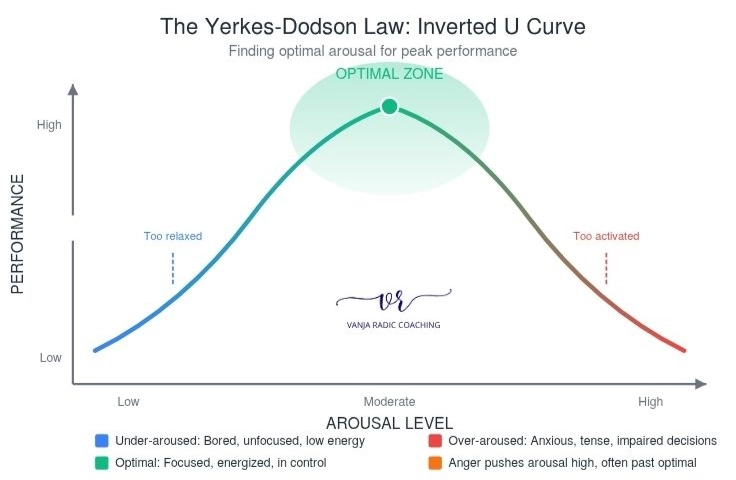
But on the other hand, athletes also can’t perform their best at extremely high arousal. When arousal goes too high, different problems emerge. Fine motor control decreases. Decision-making becomes impaired. Attention narrows too much. Muscles become overly tense. Thoughts race unproductively.
This relationship between arousal and performance is often called the “Inverted U” or the Yerkes-Dodson Law. Performance increases as arousal increases, but only up to a point. Beyond that optimal point, performance decreases as arousal continues to rise.
The goal for athletes is to find and maintain optimal arousal, high enough to be fully activated, but not so high that the costs start outweighing the benefits.
Intensity Is Arousal Plus Direction
Intensity is related to arousal but includes an additional element: focus and direction.
You can be highly aroused but unfocused. This is what anxiety often looks like. High activation, but the energy is scattered, worried, unproductive.
Intensity means high arousal that is channeled toward your performance goals. You’re activated AND focused. You’re ready to respond AND clear about what you’re trying to do. Your energy has direction.
This is the state athletes describe when they talk about being “in the zone” or “locked in”. High arousal, but it doesn’t feel chaotic. It feels purposeful and controlled.
How Emotions Affect Arousal
This is where emotion regulation connects to performance.
Different emotions create different arousal states. Fear increases arousal. Anger increases arousal. Excitement increases arousal. Anxiety increases arousal. Sadness decreases arousal. Boredom decreases arousal. Calm contentment sits somewhere in the middle.
When an athlete experiences an emotion during competition, that emotion is shifting their arousal level. A goalkeeper who gets angry after conceding a goal experiences increased arousal. A goalkeeper who feels dejected after receiving a goal experiences decreased arousal. Both shifts can move them away from their optimal performance state.
Emotion regulation, at its core, is about managing these arousal shifts. It’s about returning to or maintaining the arousal level that allows you to perform your best, even when emotional triggers are pushing you in one direction or another.
The Problem With Using Emotions as Arousal Tools
Some athletes learn to use emotions as shortcuts to arousal. They get themselves angry before competition because anger reliably increases activation. They create anxiety by focusing on potential failure because anxiety also increases activation.
These strategies “work” for some athletes in the narrow sense that they do increase arousal. But they come with costs that make them poor long-term choices.
Anger brings cognitive distortions, narrowed attention, and relationship damage. Anxiety brings worry, self-doubt, and excessive muscle tension. Both emotions shift arousal upward, but they bring baggage that interferes with performance in other ways.
The better approach is learning to increase arousal without these emotional costs. This is entirely possible. Athletes can learn to activate their bodies and minds through breathing techniques, physical movement, imagery, self-talk, and pre-performance routines that raise arousal to optimal levels without triggering emotions that bring negative side effects.
This is what elite athletes do. They know how to get themselves “up” for competition without needing anger or anxiety as fuel. They access intensity directly, rather than using emotions as unreliable intermediaries.
Finding Your Optimal Arousal Level
Different athletes have different optimal arousal levels. Some perform best with very high activation. Others perform best at more moderate levels.
Different tasks within sport also require different arousal levels. A weightlifter attempting a maximum lift might benefit from very high arousal. A golfer putting might benefit from lower arousal. A handball goalkeeper needs enough arousal to react explosively but not so much that decision-making suffers.
Learning your own optimal arousal level, and learning to access it reliably, is one of the most valuable skills you can develop as an athlete. It gives you control over your performance state rather than leaving it to chance based on whatever emotions happen to show up.
“But Anger Gives Me Power!” Understanding the Complicated Truth
If you’ve coached long enough, you’ve heard this. Maybe you’ve said it yourself. “When I get angry, I play better.” “Anger gives me fuel.” “I need that fire of anger to win.”
This belief is widespread in the world of sports, and I’m not going to tell you it’s completely wrong. That would be dismissive of real experiences that athletes and coaches have had. But I do want to unpack what’s actually happening, because the full picture is more complicated than just: “anger equals better performance”.
What’s Actually Happening When Anger Seems to Help
Anger is an activating emotion. It increases arousal, heart rate, blood flow to muscles, and adrenaline. For tasks that require raw power or explosive effort, this physiological state can temporarily boost output. A weightlifter might lift more when angry. A fighter might hit harder.
Here’s the problem: most of sport, or playing positions in the sport are not just about “raw power”. High performance requires decision-making, visual tracking, reading opponents, coordinating complex movements, communicating with teammates, and maintaining focus across an entire match. Anger interferes with all of these.
Research consistently shows that anger narrows attention. When you’re angry, you focus intensely on what made you angry, often at the expense of peripheral awareness. For example, for a goalkeeper or a defensive player who needs to track multiple players, read passing patterns, and notice subtle cues from shooters, this narrowed attention is a significant disadvantage.
Anger also impairs fine motor control and complex decision-making. The same arousal that increases gross power output reduces the precision and cognitive flexibility that high-level performance requires.
The Confusion Between Anger and Intensity
Here’s what I’ve observed over 15 years of coaching across many different cultures: many athletes confuse anger with intensity. They believe they need anger to access their highest level of activation and engagement. But these are not the same thing.
Intensity is focused energy directed toward your performance goals. It’s fully present, fully engaged, ready to respond. You can be intensely competitive without being angry.
Anger is an emotional reaction to perceived threat, injustice, or frustration. It comes with cognitive distortions, including the urge to retaliate, to prove something, to punish whoever caused the anger. These mental preoccupations take resources away from the actual task.
Athletes who rely on anger for intensity are essentially using a tool that provides some benefit (increased arousal) but comes with significant side effects (narrowed attention, impaired decision-making, relationship damage, energy drain). It’s like using a sledgehammer when you need a scalpel. 😀
The Hidden Costs of Anger-Fueled Performance
Even when anger seems to help in a moment, it creates costs that are not always immediately visible.
Energy drain. Anger is exhausting. Athletes who fuel themselves with anger often crash later in competition. Their intensity isn’t sustainable because it’s built on an emotion that burns resources faster than calmer intensity would.
Decision quality. Angry athletes make worse decisions. They take unnecessary risks. They miss opportunities that require cool assessment. They react predictably because opponents can read their emotional state.
Relationships. Angry athletes damage relationships with teammates, coaches, and referees. These relationships matter for performance. A teammate who doesn’t trust your emotional stability passes to you less. A referee who finds you difficult gives you fewer benefits of the doubt.
Inconsistency. Anger is unreliable fuel. Some days the anger shows up. Some days it doesn’t. Athletes who depend on anger for performance become inconsistent because their emotional state varies. Athletes who can access intensity without anger perform more reliably.
Learning interference. Anger blocks learning. When you’re angry during training, you’re less able to absorb feedback, notice your own patterns, and make adjustments. Development slows.
What to Do Instead
The goal isn’t to become emotionless. The goal is to access the arousal and intensity you need without the cognitive and relational costs of anger.
This starts with noticing the difference. Pay attention to how you feel when you’re performing at your best. Is it actually anger? Or is it focused intensity? Most athletes, when they examine this honestly, realize their peak performances involve intense focus and competitive drive, but not the narrowed, reactive state of true anger.
From there, you can learn to access that intensity intentionally. Pre-performance routines, breathing techniques, self-talk, and physical activation exercises can all help you reach optimal arousal without needing an emotional trigger.
Some athletes who have relied on anger for years find this transition challenging. The anger feels powerful. The alternative feels less dramatic. But drama isn’t the same as effectiveness. The athletes who learn to compete with controlled intensity rather than anger gain consistency, longevity, and usually better relationships along the way.
A Note for Coaches
If your athletes believe anger helps them, don’t simply tell them they’re wrong. They have experiences that feel real to them. Instead, help them examine those experiences more closely.
Ask: “What specifically happens when you get angry? What improves? What gets worse?” Most athletes haven’t analyzed this carefully. When they do, they often realize the improvements are narrower than they assumed, and the costs are larger.
Help them experiment with accessing intensity without anger. Give them tools. Let them compare results. The shift happens through experience, not through being told what to feel.
And check yourself too. 😉 🙂 Coaches who model anger as motivation teach their athletes that anger is necessary for high performance. If you want your athletes to regulate emotion effectively, they need to see you doing it.
Practical Strategies for Athletes
If you’re an athlete wanting to develop better emotion regulation, here are specific approaches that work.
Develop Emotional Vocabulary
Many athletes struggle to identify what they’re actually feeling beyond broad categories like “bad” or “frustrated”. Expanding your emotional vocabulary allows more precise awareness. Are you disappointed? Embarrassed? Anxious? Angry at yourself? Angry at a teammate? Each feeling is different and might benefit from different responses.
Practice naming your emotions with specificity during training, when the stakes are lower. This builds the habit so it’s available during competition.
Create a Reset Routine
Develop a specific sequence you use to return to optimal state after emotional disruption. This might include a breathing pattern, a physical gesture, a mental cue word, or a brief visualization. Practice this routine until it becomes automatic.
The routine should be brief enough to use during competition and reliable enough to trust when you need it.
Practice in Training
Training is the place to develop emotion regulation skills. Deliberately create situations that trigger emotional responses, then practice working through them constructively. Make mistakes on purpose and practice your reset routine. Have teammates create distractions while you practice refocusing.
The goal is to experience emotional challenges in lower-stakes environments where you can build skills that transfer to competition.
Use Breathing as an Anchor
Breathing is always available and directly affects physiological state. When emotions intensify, breathing typically becomes fast and shallow. Deliberately slowing and deepening breath sends calming signals to the nervous system.
A simple pattern: breathe in for 4 counts, hold briefly, breathe out for 6 counts. The exhale being longer than the inhale activates the calming branch of the nervous system. Even two or three breaths using this pattern can shift your state.
Develop Self-Compassion
Athletes with harsh self-criticism have harder times with emotion regulation because every mistake triggers not just frustration about the mistake but also attack on themselves as a person. This doubling of difficulty makes recovery much harder.
Self-compassion means treating yourself with the same understanding you would offer a teammate who made the same mistake. This doesn’t mean excusing poor performance. It means responding to difficulty in ways that support recovery rather than making things worse.
Work With a Professional When Needed
For deeply ingrained patterns or significant difficulties, working with a sports psychologist or mental performance consultant can be valuable. These professionals have specialized training in helping athletes develop emotion regulation skills.
This isn’t a sign of weakness. It’s recognition that complex psychological skills sometimes benefit from expert guidance, just like complex physical skills benefit from specialized coaching.
For Coaches: Your Regulation Matters Most
If you’re a coach reading this, I have something important to say: your emotion regulation matters more than your athletes’ because you model what they learn to do. Especially if you are working with young athletes.
Athletes watch their coaches constantly. They observe how you respond when things go wrong. They notice what you do when you’re frustrated, angry, disappointed, or stressed. Your behavior teaches them what’s acceptable and normal, whether you intend it to or not.
The coach who regularly loses emotional control is teaching athletes that losing emotional control is how intense feelings should be handled. The coach who suppresses all emotional expression is teaching athletes that feelings should be hidden and denied.
This is both a challenge and an opportunity. It’s a challenge because it means you need to develop your own regulation skills first. You can’t give what you don’t have. It’s an opportunity because improving your own regulation automatically improves the environment you create for your athletes.
Notice Your Patterns
Start by honestly observing your own emotional patterns. What triggers you? How do you typically respond? What do your athletes and colleagues see when you’re emotionally activated?
This self-awareness is the foundation for any improvement. You can’t change patterns you’re not aware of.
Develop Your Own Tools
Build your own emotion regulation toolkit. Breathing techniques, pre-competition routines, reset strategies for during competition, ways to process difficult emotions after events. Practice these until they’re reliable.
Create Team Norms Around Emotions
Explicitly discuss emotion regulation with your team. Make it part of your team culture that feelings are normal, that regulation is a skill, and that everyone is working on it together. This normalization removes shame and creates space for learning.
Respond Constructively to Athletes’ Emotional Struggles
When athletes struggle with emotion regulation, respond in ways that support their development. This doesn’t mean ignoring problematic behavior. It means addressing it in ways that teach rather than just punish.
Help athletes understand what happened, identify alternatives, and practice better responses. Create an environment where struggling with emotions isn’t shameful but is seen as an opportunity for growth.
The Ripple Effect of Good Regulation
When emotion regulation in sports improves, the effects extend beyond individual performance.
Teams with good collective regulation perform more consistently. They don’t collapse after setbacks. They support each other through difficult moments. The emotional atmosphere supports rather than undermines performance.
Athletes who develop these skills carry them into the rest of their lives. They become better partners, parents, friends, and professionals because they can work with intense feelings constructively. The investment in athletic emotional development pays dividends far beyond sports.
And young athletes who learn emotion regulation early are protected from the psychological damage that can come from years of struggling with unmanaged feelings. The teenager who learns to work with their emotions is better equipped for the challenges of adulthood.
The Question Behind the Question
Let me return to where we started. The young goalkeeper who told me he hated himself for making mistakes wasn’t just struggling with sport. He was struggling with being human, with having feelings he didn’t know how to handle, with judging himself harshly for experiences that are completely normal.
Emotion regulation in sports matters because sports are a context where humans feel intensely. How we learn to work with those feelings affects not just our athletic performance but our relationship with ourselves, our capacity for connection with others, and our overall wellbeing.
When I work with athletes on emotion regulation, I’m not just trying to help them perform better. I’m trying to help them live better. To develop a relationship with their own inner experience that serves them rather than torments them. To have tools for navigating the inevitable intense feelings that come with being alive and caring about things.
That’s what’s at stake in this work. Not just save percentages or win-loss records, though those improve too. But the quality of a young person’s inner life. Their ability to face difficulty without being harmed or destroyed by it. Their capacity to feel deeply without drowning in those depths.
That’s why emotion regulation in sports deserves serious attention. That’s why every coach and athlete should be working on this.
In Conclusion
Emotion regulation in sports is one of the most important skills for athletes and coaches, yet it remains largely untrained in most teams and clubs. The intense feelings that competition generates are inevitable. What we do with those feelings is the determining factor.
Athletes who develop strong regulation perform more consistently, recover faster from setbacks, and protect their long-term psychological health. Coaches who master their own regulation create environments that support athlete development rather than undermine it.
This is learnable. It requires awareness, practice, and patience. But the investment pays off enormously, in performance, in wellbeing, and in the quality of the athletic experience.
If you recognized yourself or your athletes in what I’ve described, take this as an invitation to start working on emotion regulation deliberately. The tools exist. The science supports their effectiveness. The only thing needed is the commitment to develop this crucial capacity.
Your feelings are part of being human. Learning to work with them skillfully is part of becoming who you’re capable of being, both as an athlete and as a person.
Stay in Touch
Do you have any coaching challenges you’d like me to address? Let me know what topics you struggle with most in goalkeeper coaching by filling out this form.
Never miss an update
Subscribe to my newsletter to receive updates about my online and in-person projects, research papers, creative projects (blog posts, books, e-books), and new online programs.
My Online Video Courses:
– Level 1 Video Course for Coaches
– Level 2 Video Course for Coaches
– Sliding Technique Video Course
– Agility Ladder Drills Video Collection – 102 drills
Subject to Copyright
Unauthorized use and/or duplication of any content from this website without express written permission from this site’s owner is strictly prohibited. All content (including text, data, graphics files, images, illustrations, videos, and sound files) contained in www.vanjaradic.fi is copyrighted unless otherwise noted and is the property of Vanja Radic Coaching. If you wish to cite or use any content from my website, please contact me first to obtain permission.
4 Responses
This is such an important conversation for the coaching community. We often forget that athletes, especially young goalkeepers, are constantly observing how we handle pressure on the sidelines. If a coach is ‘losing it’ by kicking chairs or yelling, they are unintentionally giving the athletes permission to let their own emotional tornadoes take over. I love the point that healthy regulation isn’t about being emotionless. It’s about creating that ‘thoughtful space’ between the feeling and the reaction. Improving our own regulation as coaches is perhaps the most effective way to improve the performance environment for our players.
Thank you so much for your comment and time to contribute to this important topic!
And yes, that is so true. I have witnessed some “chair kicking” and “bench kicking” coaches throughout my career, and I still can’t believe how some people let their emotional states take over them completely, in such a weird and intense way. It was scary for me as an adult to observe, let alone how it must have felt for younger players on those teams.
What annoyed me the most then (and still does now) is that when something like that happens, players are unable to do anything about it. They have to sit there and absorb whatever emotional “chaos” their coach is creating, with no power to change the situation.
I believe that coaches with serious anger management issues shouldn’t be sitting on the bench and coaching. Especially not youth players! The responsibility is too big.
We all have a continuos work to do when it comes to noticing our own triggers, creating space before reacting, and learning healthier ways to express anger and frustration. None of us are perfect at this. But awareness and effort are really important.
I really appreciate your input, and I completely agree with your point that young goalkeepers and players are constantly observing, learning, and adopting from our own reactions.
This is a very insightful point about sports psychology and coaching. Emotional intensity can definitely fuel performance, but without proper control it can also create pressure, mistakes, or conflicts during competition. I really appreciate how you highlighted the importance of emotion regulation in sports because it’s something many athletes struggle with silently. Coaches who help players channel emotions in a productive way often build stronger and more mentally resilient teams in the long run. This topic deserves far more attention in modern training programs.
Thank you for reading and for your thoughtful comment. You mentioned something I care about a lot: the difference between emotional intensity that fuels performance and emotional intensity that creates pressure and mistakes. That line between the two is where so much of the real coaching work happens. Helping athletes channel their emotions productively, rather than suppressing them or being “ruled” by them, builds the resilience that lasts. You are right that it deserves more attention in modern training programs. I appreciate you taking the time to share your thoughts. 🙂