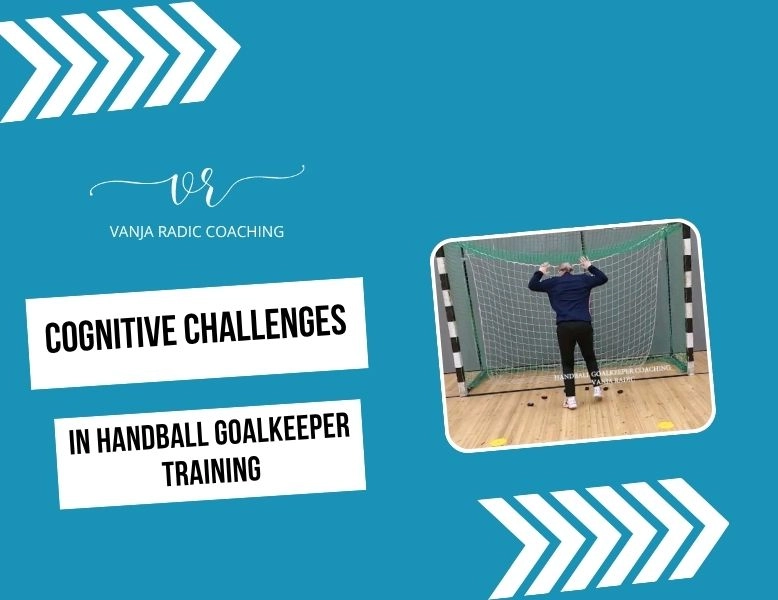
Cognitive Challenges in Handball Goalkeeper Training
When we watch an elite goalkeeper make an incredible save, we often talk about their reflexes, their athleticism, their technique. But what we’re actually witnessing is the result of something much deeper: a brain that has been trained to process information, make decisions, and execute movements at extraordinary speed. The importance of cognitive challenges in handball goalkeeper training cannot be overstated, as the role of a goalkeeper extends far beyond physical capabilities to include very fast thinking, anticipation, and decision-making under tremendous pressure.
I’ve been incorporating cognitive training into my goalkeeper work for about 15 years now, and I can tell you with confidence that this is one of the most underutilized areas in goalkeeper development. Most coaches focus almost exclusively on the physical aspects: technique, conditioning, save movements. These things matter, of course. But the goalkeeper who has the best technique will still struggle if their brain can’t process information fast enough to use that technique in real game situations.
This article is about training the brain, not just the body.
Key Takeaways
- The brain is the limiting factor more often than we realize. A goalkeeper can have perfect technique, but if their brain can’t process and decide fast enough, they won’t make saves. Cognitive training addresses this directly.
- Cognitive abilities are trainable. Decision-making speed, reaction time, focus, and visual processing all improve with deliberate practice. The brain adapts to the demands we place on it.
- You don’t need expensive equipment to start. Simple additions like color calling, odd/even decisions, or unpredictable sequences can transform physical drills into cognitive challenges.
- Light signaling systems take training to the next level. These tools provide precise, measurable, and highly variable stimuli that challenge the brain in ways that transfer directly to game performance.
- Cognitive training builds confidence and resilience. Goalkeepers who have trained their brains trust themselves more under pressure and recover faster from mistakes.
Why the Brain Matters More Than We Think
A shot comes from 9 meters. The ball is traveling at 80-100 km/h. From the moment the shooter releases the ball to the moment it reaches the goal line, the goalkeeper has somewhere between 300-400 milliseconds to react. That’s less than half a second.
In that tiny window of time, the goalkeeper’s brain must:
- See the ball leave the shooter’s hand
- Process the visual information about trajectory, speed, and spin
- Decide which save technique to use
- Send the motor command to the relevant body parts
- Execute the movement
If any part of this chain is slow, the save doesn’t happen. The most technically perfect goalkeeper in the world will let in goals if their brain can’t process and decide fast enough to allow their body to respond in time.
This is why cognitive challenges are not optional “extras”. They’re fundamental to goalkeeper performance.
What Cognitive Training Actually Develops
When I talk about cognitive training for goalkeepers, I’m talking about deliberately challenging the brain’s processing systems to make them faster and more efficient. Here’s what this kind of training actually develops:
Decision-Making Speed and Quality
Goalkeepers constantly face split-second decisions during a game. What kind of positioning or save reaction to apply? What is the trajectory of this shot? Should I stay or should I step forward? Cognitive training sharpens the decision-making process, enabling quicker and more accurate responses to game situations.
The beautiful thing is that decision-making is trainable. When we expose goalkeepers to situations where they have to make fast decisions repeatedly, their brains literally get better at it. The neural pathways become more efficient. The processing becomes faster. What once required conscious thought becomes automatic.
Reaction Time
Cognitive challenges designed to improve reaction times are crucial for goalkeepers. The ability to react quickly to shots, especially from close range, can be the difference between a save and a goal. By simulating game-speed scenarios in training, goalkeepers can develop faster neural responses.
But here’s something important to understand: reaction time isn’t just about how fast your muscles can move. It’s primarily about how fast your brain can process the stimulus and initiate the response. The physical movement is only the final step. If we want to improve reaction time, we need to train the processing, not just the moving.
Concentration and Focus
Handball goalkeepers need to maintain high levels of concentration throughout a match, despite varying periods of activity. This is one of the most challenging aspects of the position. Your team might have possession for two or three minutes, and then suddenly the ball is coming at your goal and you need to be fully ready.
Cognitive challenges help in improving focus, allowing goalkeepers to stay engaged and ready to respond to potential threats even after periods of inactivity. We can train the brain to sustain attention, to stay present, to resist the natural tendency to drift when nothing is happening.
Anticipation and Prediction
Cognitive training helps goalkeepers better predict opponents’ actions and movements, improving their ability to anticipate shot directions and strategies. This is where game intelligence lives. The goalkeeper who can read what’s about to happen before it happens has a massive advantage.
Exercises that simulate attacking patterns, use video analysis to study shooters’ tendencies, or require cognitive challenges that involve pattern recognition can all improve these predictive skills. The brain learns to pick up on cues earlier and process them faster.
Visual-Spatial Awareness
Training that challenges goalkeepers to track multiple objects or react to visual cues can improve their visual-spatial awareness. This is vital for accurately judging the speed and direction of shots and for effective positioning.
The visual system is one of the most important information input systems for goalkeepers. We get about 75-80% of all information about the world through our eyes. If we’re not training this system, we’re neglecting the primary channel through which goalkeepers receive the information they need to make saves.
The Mental Side of Physical Performance
I want to address something that often gets overlooked. Cognitive training isn’t separate from physical training. It’s deeply connected.
When a goalkeeper is struggling with their performance, we often assume it’s a technical problem or a physical limitation. Sometimes it is. But often, the real issue is cognitive. The goalkeeper might have excellent technique, but their brain is overwhelmed by the speed of information coming at them. They might be physically capable of making a save, but they can’t decide fast enough which save to make.
Cognitive challenges in training address this connection between mind and body. When we train the brain to process faster, decide faster, and focus better, we unlock physical abilities that were always there but couldn’t be expressed.
I’ve seen goalkeepers who looked average suddenly become excellent when their cognitive processing improved. Nothing changed about their technique. Nothing changed about their physical abilities. What changed was their brain’s ability to use what they already had.
Stress and Pressure Management
The mental resilience to handle stress and pressure is crucial for handball goalkeepers. And this resilience can be trained.
When we introduce cognitive challenges that mimic high-pressure situations, we’re not just training skills. We’re training the nervous system to remain functional under stress. We’re teaching the brain that it can handle complexity and time pressure without shutting down.
Think about what happens to an untrained person under pressure. Their thinking becomes narrow. Their processing slows down. They make poor decisions or freeze entirely. This is the stress response doing what it evolved to do: preparing the body for fight or flight.
But goalkeepers can’t afford this response. They need to think clearly and act precisely under maximum pressure. Cognitive training that includes elements of stress, time pressure, and complexity helps goalkeepers develop the ability to stay mentally sharp when everything is on the line.
Adaptability and Flexibility
Incorporating a variety of cognitive challenges in training prepares goalkeepers for the unpredictable nature of handball matches. No two shots are exactly the same. No two game situations are identical. The goalkeeper who has only trained predictable scenarios will struggle when reality doesn’t match their training.
Cognitive training fosters adaptability, allowing goalkeepers to adjust their strategies and techniques as the game evolves. When the brain has been exposed to variety, complexity, and unpredictability in training, it becomes better at handling these elements in competition.
This is why I love creating exercises that combine multiple elements: footwork with decision-making, save movements with visual processing, technical work with cognitive load. The brain learns to handle complexity, which is exactly what it needs to do in matches.
Practical Methods: From Simple to Advanced
Now let’s talk about how to actually implement cognitive training. The good news is that you don’t need expensive equipment to get started. The principles can be applied with simple tools and creative thinking.
Low-Tech and No-Tech Options
Before we talk about advanced technology, let’s cover what you can do with minimal resources.
Color or number calling: During any physical drill, add a decision-making element. Call out a color, number, or direction, and the goalkeeper must respond with a corresponding action. This simple addition transforms a physical drill into a cognitive challenge.
Odd/even reactions: Show numbers with your fingers. The goalkeeper performs one movement for odd numbers and a different movement for even numbers. This requires processing and decision-making before the physical response.
Multiple stimulus sources: Have the goalkeeper respond to visual cues from one direction while also listening for audio cues from another. This divides attention and trains the brain to process multiple information streams.
Unpredictable sequences: Instead of predictable drill progressions, randomize the order and timing of exercises. The goalkeeper never knows exactly what’s coming next, which keeps the brain engaged and adaptive.
Vestibular system activation: Include 180 or 360 degree jump turns in your drills. Upon landing, the goalkeeper must immediately process new information and respond. The vestibular challenge combined with the cognitive demand creates powerful training stimulus.
These methods cost nothing but add tremendous value to your training sessions. The key is intention. You’re not just doing physical work; you’re deliberately challenging the brain.
Using Light Signaling Systems
The first part of a goalkeeper warm-up, which comes before shooting with handball balls, can be used for footwork combined with additional cognitive challenges that are highly valuable for every position in handball, but especially for goalkeepers: the speed of information processing and speed of decision making.
For additional information about the importance of footwork in handball, please check out that article on my website.
Light signaling systems take cognitive training to another level. There are many available on the market, and they all work on similar principles: providing unpredictable visual stimuli that the goalkeeper must process and respond to quickly.
Video Example: Combining Multiple Cognitive Elements
In the video below, a goalkeeper is reacting with fast leg swings on different visual tasks that are shown on semaphores of the TestYou brain training system. Every time, on each semaphore, there is a different color, number, or symbol.
In addition to that footwork, on a sudden, unexpected audio stimuli given by the coach, the goalkeeper needs to make a 180 degree jump turn (which is direct vestibular system stimulation). Once the jump turn will be to the left side, the next time it will be to the right side.
Right upon landing after the 180 degree jump turn, there will be another task for the goalkeeper: the other goalkeeper or the coach will show an even or an odd number (the number can be shown with fingers of one or of both hands). Following tasks are different for shown odd numbers and for even numbers. So depending on which number will be shown, the goalkeeper needs to make a fast decision and perform a different set of movements.
Combinations of options of save movements that can be done in this exercise are literally endless, as well as the choice of stimuli (audio, visual, or tactile), and also there can be added additional cognitive tasks.
With brain training systems like TestYou, you get to work on a more challenging level of brain training because you are not reacting only to a given color of light on a semaphore, but you have to react to a specific symbol (that can be a number, a letter, or a symbol) and also to a specific color. While all along, colors and symbols are mixed up and you really need to be able to engage your brain, ignore the irrelevant information, decide fast, and react with the proper reaction to the given color and symbol.
This combo cognitive drill is quite challenging, fun, and extremely efficient! 🙂
Benefits of Light Signaling Systems
Integrating cognitive challenges into handball goalkeeper training through light signaling systems presents numerous benefits that go beyond traditional physical training methods. Here’s how these systems can specifically benefit handball goalkeepers:
Improved Reaction Times
Light signaling systems provide unpredictable stimuli that goalkeepers must respond to quickly, mirroring the fast decision-making process required during matches. Training with these systems can significantly reduce reaction times, as goalkeepers learn to process visual cues and execute physical responses more quickly.
The unpredictability is key. When the goalkeeper doesn’t know what’s coming next, they can’t pre-plan their response. They have to actually process and react, which is exactly what happens in games.
Improved Decision-Making Under Time Pressure
Cognitive challenges with light signals demand that goalkeepers make split-second decisions based on the stimuli presented. This practice translates directly to game situations where goalkeepers must constantly assess the play, predict opponents’ actions, and decide on the best course of action under pressure.
The more often a goalkeeper practices making fast decisions, the better they become at it. The neural pathways get stronger and faster with repetition.
Increased Visual Processing Speed
Using light signaling systems in training improves goalkeepers’ ability to process visual information quickly. The fast interpretation of light patterns and subsequent physical response closely mimic the visual processing needed to track the ball and opponents’ movements during a match.
This is one of the most direct transfers from training to performance. The visual system that processes lights in training is the same visual system that processes shots in games.
Boosted Concentration and Focus
The unpredictable nature of light signaling systems requires sustained attention and focus from goalkeepers. This aspect of cognitive training is invaluable, as maintaining high levels of concentration throughout a match is crucial for optimal performance in goal.
When goalkeepers train with systems that demand constant attention, they develop the mental stamina to stay focused during long matches.
Development of Motor Skills and Coordination
Cognitive challenges that incorporate physical responses to light signals foster the development of fine motor skills and coordination. Goalkeepers must often move their hands, feet, and body in response to the lights, improving their overall agility and coordination.
The brain-body connection strengthens. The communication between the processing systems and the motor systems becomes faster and more precise.
Stress and Fatigue Management
Training under cognitive load with light signaling systems helps goalkeepers learn to manage stress and fatigue effectively. The mental resilience developed through such training is critical for late-match scenarios when physical and mental fatigue set in.
This is when cognitive training really pays off. In the 55th minute, when legs are heavy and concentration is wavering, the goalkeeper who has trained under cognitive load will maintain performance better than one who hasn’t.
Personalized Training and Feedback
Many light signaling systems come with the capability to record performance data, providing immediate feedback. This feature allows for personalized training sessions tailored to the goalkeeper’s specific needs and the tracking of progress over time.
Data is powerful. When you can measure reaction times, accuracy, and consistency, you can identify specific areas for improvement and track whether your training is working.
Integrating Cognitive Training Into Your Training
You might be wondering how to actually fit cognitive challenges into your existing training program. Here are some practical suggestions:
During Warm-Up
The warm-up is an ideal time for cognitive work. The brain needs activation just like the body does. Include footwork drills with decision-making elements, visual tracking exercises, or reaction challenges during this phase.
Combined With Technical Work
Any technical drill can become a cognitive drill by adding decision-making elements. Instead of just practicing a save movement, practice deciding which save movement to use based on a stimulus. This combines technical repetition with cognitive training.
Dedicated Cognitive Blocks
If possible, include dedicated blocks of cognitive training in your program. These can be short, 10-15 minutes, but focused specifically on challenging the brain’s processing systems.
Progressive Complexity
Start simple and add complexity over time. A goalkeeper who has never done cognitive training shouldn’t start with the most challenging drills. Build the foundation first, then add layers of difficulty as the brain adapts.
What I’ve Learned From 15 Years of This Work
Over the years of incorporating cognitive challenges into my goalkeeper training, I’ve observed some consistent patterns.
First, goalkeepers who train cognitively become more confident. There’s something about knowing that your brain has been trained for speed and pressure that gives you mental security and confidence. You trust yourself more because you’ve tested yourself in demanding situations.
Second, the transfer to games is real. Goalkeepers consistently report that game situations feel “slower” after cognitive training. What they’re actually experiencing is faster processing, the game hasn’t slowed down, but their brain has sped up, which creates the perception of having more time.
Third, this work is enjoyable. Goalkeepers genuinely like cognitive training. It’s challenging in a different way than physical work, and the variety keeps training engaging. I’ve never had a goalkeeper complain about doing cognitive drills.
Fourth, it helps with recovery from mistakes. Goalkeepers who have trained their cognitive systems bounce back faster from goals conceded. Their brains are better at processing what happened, letting it go, and refocusing on the next moment. This mental resilience is invaluable.
A Note on Age and Development
I want to mention that cognitive training is appropriate for all ages, but it should be adapted to developmental stage.
Young goalkeepers benefit enormously from cognitive work because their brains are still developing and highly plastic. The neural pathways we build in youth become the foundation for adult performance. Starting cognitive training early creates advantages that compound over time.
For younger athletes, keep the cognitive challenges playful and game-like. They don’t need to know they’re doing “brain training.” They just need to be engaged in activities that challenge their processing, decision-making, and reaction systems.
For more experienced goalkeepers, the challenges can be more sophisticated and more directly connected to specific game scenarios they face.
In Conclusion
Cognitive challenges in handball goalkeeper training are essential for developing a well-rounded, mentally agile athlete. By focusing on the mental aspects of goalkeeping, we can elevate our goalkeepers’ performance, ensuring they are not only physically but also mentally prepared to face the demands of high-level competition.
The brain is trainable, just like the muscles. The processing systems can get faster. The decision-making can improve. The focus can be developed. All of this requires intentional training, just like any physical quality.
When we train the brain alongside the body, we create goalkeepers who can actually use their physical abilities when it matters most. We create goalkeepers who stay sharp under pressure. We create goalkeepers who see the game differently because their brains process information faster than their opponents expect.
This is the edge that cognitive training provides. And it’s available to any coach willing to incorporate cognitive challenges into their training program.
If you want to learn more about cognitive training and how I integrate it into goalkeeper development, check out my article on cognitive training in handball goalkeeping. You might also be interested in visual and vestibular training with handball goalkeepers.
Video – Selective Attention Training With Light Systems
One of the most effective ways to train cognitive skills in goalkeepers is through light-based training systems. These systems challenge the brain to process visual information quickly and make decisions under time pressure.
In the exercises shown in this video, the goalkeeper reacts with a hand to a specific symbol of a specific color, using the TestYou Brain Training System. The coach decides which symbol and color combination the goalkeeper should respond to. Meanwhile, any of the 6 semaphores can randomly display any of the 250 different available symbols in any of the possible colors. This makes it far more challenging than working with simpler light systems where the goalkeeper just reacts to any stimulus.
This type of training targets a cognitive skill called selective attention: the ability to focus on specific relevant stimuli while ignoring irrelevant or distracting information. In a real game, goalkeepers are constantly bombarded with visual information. Players moving, arms waving, feints, the ball changing hands. The ability to filter out what doesn’t matter and lock onto what does matter is what separates good decision-makers from goalkeepers who get fooled or overwhelmed.
I use a lot of drills and exercises that include selective attention training in my coaching, because I have noticed that my goalkeepers show significant improvements with them. Improving selective attention can lead to significant gains across all levels of sport, enabling athletes to maintain focus, react quickly and accurately, and perform at their best even in the most pressure-filled moments. 🙂
This is where we specifically get to target certain regions in the brain that are devoted to ignoring the non-important information (which is a valuable feature in sport). We get to work on a speed of decision making, speed of information processing, speed of reaction and on advanced level of eye-hand coordination.
In the first version of the exercise, the goalkeeper is instructed to react on a given stimuli on the right three semaphores with the right hand, and on the three left semaphores with the left hand. Before reacting, the goalkeeper should free that hand by throwing the bean bag (or any other object) in the air, then reacting on a proper symbol above the corresponding semaphore, and then catching the bean bag before it falls on the floor.
In the second version of this exercise, the goalkeeper should throw both bean bags in the air, react on a given symbol above the corresponding semaphore, with pre-decided hand and then catch both bean bags before they fall on the floor.
Video – Footwork With TestYou Brain Training System
You can always use warm up time to work on footwork combined with some additional cognitive tasks. Including cognitive tasks in the training process is highly valuable for every position in handball (or in any other sport), but especially for handball goalkeepers. You can read more about the benefits of cognitive training here.
In the video below, you can see an example of a footwork exercise with the TestYou brain training system, with the main focus on improving the speed of information processing and improving the speed of reaction.
In addition to that, we worked on another very important aspect, on selective attention – the ability to ignore the non-important information or stimuli.
With the TestYou brain training system, you get to work on a more challenging levels of cognitive training, because you are not reacting only on a given color of the light, but you have to react on a specific symbol (number, letter or a symbol) and also on a specific color. While all along, colors and symbols are mixed up all the time, wince TestYou offers 250 different symbols (including symbols, letters, and numbers).
You really need to be able to engage your brain, ignore irrelevant information, decide fast and react with proper reaction on a given color and symbol.
Video – TestYou Brain Training System – Some of The Exercises Options and Ideas
In the video below, you can see some of the exercises with TestYou Brain Training System for improving the speed of decision making. The options of exercises and levels of difficulty with TestYou Brain Training System stop just about when your creativity stops, meaning – never!
Stay in Touch
Do you have any coaching challenges you’d like me to address? Let me know what topics you struggle with most in goalkeeper coaching by filling out this form.
Never miss an update
Subscribe to my newsletter to receive updates about my online and in-person projects, research papers, creative projects (blog posts, books, e-books), and new online programs.
My Online Video Courses:
– Level 1 Video Course for Coaches
– Level 2 Video Course for Coaches
– Sliding Technique Video Course
– Agility Ladder Drills Video Collection – 102 drills
Subject to Copyright
Unauthorized use and/or duplication of any content from this website without express written permission from this site’s owner is strictly prohibited. All content (including text, data, graphics files, images, illustrations, videos, and sound files) contained in www.vanjaradic.fi is copyrighted unless otherwise noted and is the property of Vanja Radic Coaching. If you wish to cite or use any content from my website, please contact me first to obtain permission.
No responses yet