How to Coach Handball Goalkeeper Technique: Making a Complicated Topic Simple
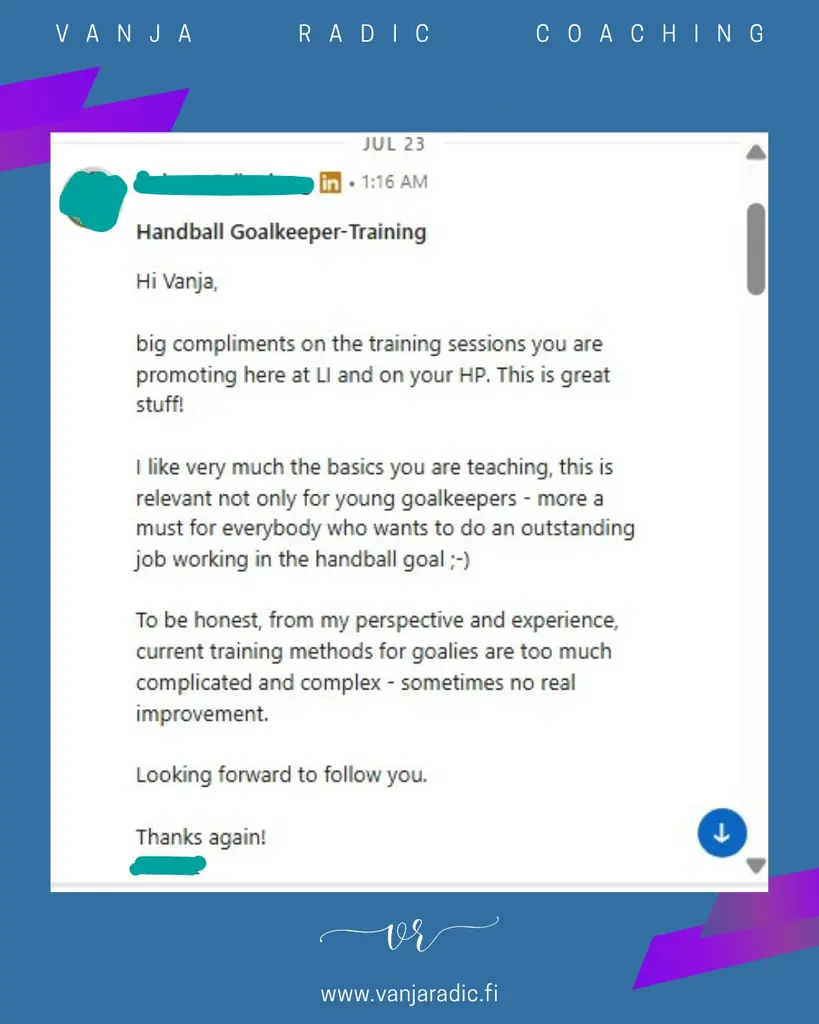
A coach wrote to me a few weeks ago with a message that stayed on my mind. He thanked me for the training and educational materials I share online, and then he told me something many coaches feel and only few say out loud: current methods for training goalkeepers have become too complicated, and all that complexity often brings no real improvement. And he is right. When coaches ask me about coaching handball goalkeeper technique, my plain starting point is that the topic has been made harder than it needs to be, and a lot of good information stays locked away where new coaches can’t reach it. This post is my attempt to open that door and make the whole subject more simple for you.
I’ve spent more than twenty years coaching goalkeepers, and teaching and educating other coaches, on several continents and at every level from young newcomers to national teams and high professional level. In that time I’ve watched a strange pattern repeat itself: goalkeeper coaching gets treated as some “secret art”, passed down in fragments, explained in long, confusing clouds of words that leave you with no clear answer. My goal here is a different one. I want to offer my own simple structure to other coaches, one that any coach can use tomorrow, so that teaching handball goalkeeper technique feels possible instead of overwhelming. This post keeps its focus on goalkeeper technique, which is one piece of a much bigger job that also includes several other aspects, some of which are tactics, physical preparation, and mental training.
Key Takeaways
- Goalkeeper coaching knowledge often gets gatekept and over-complicated. Experienced coaches can help most by breaking it into simple, chewable parts and sharing those parts openly (if they choose to do so).
- Coaching handball goalkeepers is more manageable job than it first sounds. Handball goalkeeping runs on a handful of save technique movements, and each goalkeeper performs those same movements in their own way.
- To simplify the entire process, you can use my three-group method: sort every element of handball goalkeeper technique into one of these three groups: safety constraints, efficiency near-universals, and individual space. The group it lands in tells you how to coach it.
- Teach safety directly and early. For example, the arm stays ahead of the body line for saves of high shots, because the shoulder and elbow pay the price for a wrong position (behind the body line).
- Protect the principles that keep a goalkeeper safe and efficient, and leave room for the personal details that make each goalkeeper themselves.
The Gatekeeping Problem in Goalkeeper Coaching
Let me name the problem right away, because naming it is the first step toward solving it. Handball doesn’t have that many specialist goalkeeper coaches who actually know what they are doing, and who are doing a good, dedicated job. Most clubs give the young goalkeeper training to a field coach, who never played the position, (or to a little bit older goalkeeper than the ones that needs to be coached, or to a parent who wants to help but never played handball or goalkeeper position), or they leave the young keeper to “copy/paste” whatever they find online in training videos. So the young goalkeeper grows up guessing, and often, unexperienced goalkeeper coach guesses too. Anyone trying to learn handball goalkeeper technique runs into this wall fast, and it can feel quite lonely.
On top of low level of support for goalkeepers is something that really bothers me: handball goalkeeper coaching gatekeeping. Many good and experienced goalkeeper coaches keep their knowledge somehow half-hidden. You ask them a direct question about something, and the answer comes back wrapped in so many “around ways”, conditions and side notes that you walk away with nothing you can use in your work. I understand some of the reasons behind it. I guess, some coaches worry that if they share their methods, they will lose what makes them / their work special. Others simply never learned to break their own knowledge into simple steps, because nobody ever did that for them. Whatever the cause, the result is often the same, and it keeps our sport back: goalkeeping stays hard to understand, hard to teach, and hard to coach.
Also, one phrase does more damage than most, in a way that is hard to see at first. You will hear respected goalkeeper coaches say that every goalkeeper is completely different, so every goalkeeper needs a completely different technique. This sounds wise and open-minded, and part of it is true. But for a new coach, though, it comes like a locked door, like a huge wall, because it hints that there is no shared ground to stand on and that there is nothing solid to teach. A young goalkeeper picks up a version of the same message and starts to believe the position is a “mystery” that only a “chosen few” can understand. That belief is a big part of what keeps people stuck, and it makes coaching handball goalkeeper technique sound far harder than it really is.
So I want to say something clearly to the coaches who already have a lot of knowledge and experience: our job is to open the door for the next coach and hold it open behind us. When we understand something well, the useful move is to break the complex topic into smaller, simpler, more chewable parts, and to be able to hand those parts to the next coach in plain words. Good knowledge in this position should never be a “secret” that depends on being “lucky” enough to sit next to the right person for five or ten years, until we can observe and figure it out over time by ourselves. It should be teachable, and it should be shared freely.
I get messages about this often, and many of them sound similar. A coach describes a real goalkeeper with a real problem, and asks me for one clear answer. When I give a short, direct reply, the relief in their next message is easy to feel. That relief tells me the coaching appetite is there. Coaches want this craft to be understandable and teachable, step by step, in words they can repeat to a twelve-year-old the same day. Giving them that is the whole reason I keep writing and sharing all my educational materials, and it is why I built a simple way to teach handball goalkeeper technique.
The Myth of “Every Goalkeeper Needs a Different Technique”
Let me unpack this phrase, because it’s way more simple than it sounds. One part of it is true: every goalkeeper really is different. The problem starts with the jump to: “every goalkeeper needs a completely different technique,” which is where new coaches get confused. We don’t actually have so many different goalkeeper saving techniques in the handball game. The sport has a small set of saving goalkeeping movements, and each goalkeeper performs them in their own slightly personal way.
Think about what that means for you. When you learn handball goalkeeper technique, the real task is smaller and easier than it first looks. You learn a handful of basic, main movements, and then you add the judgment to let each goalkeeper adapt and perform those movements around their height, their reach, their physical capabilities, and their timing. Their individuality lives in how they perform the basics, while the basics themselves stay steady underneath their own goalkeeping style. This is exactly what skill-learning research describes, where athletes reach a shared goal through slightly different movement solutions. That is a way lighter load to carry than the myth “every goalkeeper needs a completely different technique” suggests, and it gives you a clear place to start with any goalkeeper who walks into your sports hall.
It seems that the wording in handball goalkeeper coaching world is what’s creating the problem. When some coaches say that we should teach every goalkeeper a different goalkeeper technique, what they usually mean is that the main principles of the movement (of the technique) stay the same, and each goalkeeper’s interpretation of those principles will always be individually interpreted as their own style. Calling that “different technique” confuses new coaches, because it hides the same foundation of the basic elements of technique underneath. The clearer words are these: there are shared principles of basic technique, but every goalkeeper has individual style, their own way of performing the basic technique.
The difference between a goalkeeper technique and goalkeeper style is one of the first things that I talk about in my Level 1 Video Course for coaches, which is all about basic stance, movement in front of the goal, positioning, angles, and saving techniques for saves of high, middle, and low shots from 9 meters.
A Simple Way to Sort Handball Goalkeeper Technique
Over the years of coaching goalkeepers, I built my own approach.
In my own approach, I like to split a complicated topic down into simple steps that any other coach can work with.
Let me make two words clear before we go on, because they are very important. A technique, or a movement, is the whole coordinated action for one kind of save. Take the high shot to goalkeeper’s left side from nine meters as an example. The goalkeeper starts in the basic stance, pushes off the right leg, extends the left arm to meet the ball, keeps that arm a little ahead of the body line, adds a side-knee reaction to lift the reacting leg (which is the left leg in this case), and lands with the left foot open. All of that together is one technique for saves of high shots from 9 meters.
An element of technique is one single task inside that whole movement, usually what one body part does or one detail of the action (either the push-off leg movement, or the reacting leg movement, or the reacting arm movement, or the non-reacting arm position). In that same high save technique, the elements of that technique are things like the push-off from the right leg, the left-arm extension, the left arm going a little bit towards the ball – being positioned ahead of the body line, the side-knee lift of the reacting leg, the open landing foot of the reacting leg. Each of those is an element of the technique.
So my own goalkeeper coaching method is simple. When I work on any goalkeeper save technique, I split it into its elements. Then I take one element of that technique at a time and I “place” it into one of three groups. This single habit takes most of the confusion out of the work, because each group comes with its own clear instruction about how much to teach goalkeepers and how much to leave “open” for their own interpretation (which will become their own goalkeeping style).
The three groups that I place an element of technique in are:
- safety constraints,
- efficiency near-universals, and
- individual space (individual goalkeeper interpretation and style).
Safety constraints protect the body from potential injury. For example, if we are working on saving technique of high shots from 9 meters, and if we are working on the reacting arm reaction and position in that technique (which is one isolated, one single element of that save technique), then I will explain and show to my goalkeepers that the extended arm position has its owen principles, and that it can’t be positioned behind the line of the body, because like that it has the smallest “muscle support”, and while getting a strong impact from a strong shot – the elbow or shoulder of that arm could be injured. So I will teach my goalkeepers that there shouldn’t be “individual style” or exploration for that specific element of technique (because it might cause an injury).
Efficiency near-universals are the movement patterns that physics rewards almost every time, that make the save movement the most efficient almost every time.
Individual space has the personal details (own goalkeeper interpretation, own goalkeeper style) that can and should look different from one goalkeeper to the next.
So the order is: first you look at an element of the movement (say, the push-off leg in high save technique), then you decide which of the three groups it belongs to, and only then does the teaching approach fall into place (teach it directly, or open it for exploration). Once you can understand and see to which of these 3 groups a technique element belongs to, then the teaching approach follows on its own: you teach the safety and near-universal parts directly (as they are), and you open the individual parts for goalkeeper’s own exploration. What I mean with “teaching directly” is that I demonstrate and explain the correct way, I explain why it works, and then the goalkeeper has a clear understanding, and the goalkeeper practices that same way from the start, because these parts have logic behind them. Opening a part for exploration means I let the goalkeeper try a few versions of that element, to see what feels the best, and what seems the most efficient, and then we keep the one that works best for their body. If we look again at that example for saves of high shots. The push-off from the opposite leg is a near-universal – every single top level goalkeeper performs it in that way. Keeping the reacting arm a little bit in front of the body line is a safety point. The exact height of the hands and arms in basic stance (before starting to react to the high shot), or the exact push off leg position is individual.
You are maybe wondering why there are exactly three groups, and not a long checklist of twenty or forty coaching points. Well, a long list demands from you to memorize a lot and keep track of too many things. Three groups demand from you to understand deeply, and understanding goes with you into situations the list never mentioned. When a new movement or an odd save shows up in training, you don’t need someone to have written a “rule” for it in advance. You sort it immediately on the spot: does this protect a joint, does physics decide it, or does it belong to the goalkeeper’s own style? That fast sorting is the practical core of simple coaching handball goalkeeper technique, and it keeps you from drowning in detail.
I just want to mention one more thing before the examples, because I care about giving credit where it is due. 😊 The individual words in the model that I am using in my work (safety constraints, efficiency near-universals, and individual space) come from motor-learning science. Constraints sit at the center of the constraints-led approach, which grows from Newell’s model of task, environment, and individual constraints. The idea of near-universal or invariant patterns is common language in movement science for movements that are the same for almost every goalkeeper, usually for reasons of physics or biomechanics. And individual space, the room a performer has to find their own solution, is very close to ideas in ecological dynamics and nonlinear pedagogy about individual movement solutions. So the vocabulary has deep roots in already existing theory, and I want that to be clear. 😊
So I didn’t come up with those terms, and I just wanted to clarify that for any curious coaches out there. But what I did put together (and what works for me in my goalkeeper coaching work) is the framework itself. Sorting handball goalkeeper technique into these three specific groups, safety constraints you teach directly, efficiency near-universals are driven by physics and biomechanics, and individual space you open for goalkeeper’s exploration, and then using that sorting as a coaching tool in goalkeeper training, is my own integration. I haven’t seen this exact three-part model published by anyone else. So I offer it as my way of organizing known ideas, tested over many years with goalkeepers. And also, it brings more clarity to the whole topic of “every goalkeeper needs a different technique”.
Video Example of Handball Goalkeeper Technique vs Goalkeeper Style
To be honest, it’s getting confusing even for me when I hear some coaches say that “every goalkeeper needs a completely different technique.” We don’t actually have so many different goalkeeper saving techniques in handball, so it can’t be that every single goalkeeper has a different technique. Our sport has a fairly small set of saving goalkeeping movements, and each goalkeeper performs them in their own slightly personal way.
For example, in this video you can see a save technique called “leg kick” (and there are probably many different names for it). You can see all these different goalkeepers performing that same leg kick technique, but each of them performs it in a slightly different way. They are all performing the same movement in their own individual style.
So these goalkeepers are not using different techniques. Each of them is interpreting the same technique in their own way, and that personal interpretation is what we call goalkeeper style.
A goalkeeper technique is the whole saving movement for one kind of shot. An element of technique is one single task inside that movement, for example which leg is the push-off leg when the shot comes to the goalkeeper’s right side, or which leg makes the kick.
A goalkeeper style is how one goalkeeper performs a technique, or the elements of a technique, shaped by things like their body, their reach, their timing, and their physical abilities.
Safety First: The Parts You Teach Directly
The first group is the one I never leave to chance. Some elements of goalkeeper technique are closely connected to the safety of a joint that they stop being a matter of goalkeeper own style, and the reacting arm position in a save of a high shot from 9 meters is my clearest example. If you imagine a powerful shot from nine meters flying toward the goalkeeper’s high corner. The goalkeeper reaches to save it. If that extended arm is positioned behind the line of the body, the angle loads the shoulder and the elbow at the worst possible moment, right as a hard shot arrives. The safer position keeps the arm a little ahead of the body and angled toward the ball, so the force passes through a joint that can take it. Teaching that safe position first is the base lesson in handball goalkeeper technique for saves of high shots from 9 meters that keeps a goalkeeper safe and healthy.
This is simple physics meeting a young body. The shoulder is already one of the most injured areas in handball, and research on adolescent handball players shows how often shoulder problems appear at that age. A thirteen-year-old should never have to learn the safe arm position by “exploring” the movement or by feeling an injury, and then carry the consequences of that injury for years. Good shoulder injury prevention is well understood, and it starts with teaching proper positions early. So I teach this detail directly and right away. I show it, I demonstrate it slowly and then at speed, first without shots and then with shots, through clear progression steps, until the safe position is the one that appears on its own under pressure.
When we teach safety this way, we protect the young goalkeepers standing in front of us, and that protection is big part of our coaching job, especially if we are working with young athletes. You can build this straight into the foundation of a goalkeeper’s movement. Safety is the part of handball goalkeeper technique I teach most directly of all. Some handball goalkeeper coaching voices say that we should let goalkeepers explore and find their own solutions (save techniques and movements), and I agree with that, but in the right places. Exploration has its place in the personal details. Safety of the joint belongs in a group of its own, taught directly, every time. At least it’s like that in my opinion. And I always make sure to explain clearly why and how I teach everything that I teach.
The Near-Universal Patterns: Physics You Can Trust
The second group is about the movements that almost every goalkeeper ends up doing, because they work best. My favorite example is the push-off-leg (the drive leg). For any save movement (high, middle, or low), the drive, the push-off comes from the leg opposite to the side of the reaction. For example, if the ball is coming to the goalkeeper’s right high side, the push comes from the left leg; and if a ball comes to the goalkeeper’s left side, then the push is driven by the right leg. This is true for high, middle, and low shots, and it is true for tall goalkeepers and shorter ones alike. It doesn’t change with personal taste, because the physics of driving the body sideways doesn’t care about preference.
The push-off leg is the clearest case, but it isn’t the only one. Keeping your body weight slightly on the front part of both feet is another near-universal example, because it lets a goalkeeper drive in any direction without having to waste any time on transitioning body weight from the back part of feet (in the case if the body weight would be completely on the back part of feet – on heels). Settling the eyes on the ball as it leaves the hand of a shooter is another example, because the information a goalkeeper needs arrives through their eyes. Patterns like these come from how the body and the ball behave, so you can teach them with confidence to any goalkeeper, and then let each goalkeeper add their personal “flavor” on top. Trusting these patterns takes a lot of confusion out of learning handball goalkeeper technique.
Coaches find the next part liberating in a way. You can teach this pattern in two ways at once, and they work together. One way is to explain it directly, in plain words, so the goalkeeper understands for example why the opposite leg drives. Another way is to design exercises that ask for real reach and real speed, so the correct leg appears on its own. Doing both at the same time is a strong route to work on. When you understand this second group, a big part of the work turns from guesswork into something you can predict and plan for.
Individual Space: Where a Goalkeeper’s Style Grows
The third group is where a goalkeeper “becomes themselves”, where they get the space to develop their own style. Details like the exact starting position of the arms in basic stance, the height of the hands, the width of the stance, the position of the hands, the rhythm of the ready position, the movement, and how deep a goalkeeper stands on their movement arc can all be individual, and often they should be. This is the space where you let a goalkeeper try, ask them how it felt, and guide the next attempt, so their own answer has space to grow. The individual side of handball goalkeeper technique is the part that brings me the most joy, because you get to watch a person appear inside the movement. 😊
Let me show you how an exploration moment looks in practice, because the idea can sound vague until you actually understand it. First, I set up a save the goalkeeper can already do, then I offer a small change: “try your hands a touch higher this time, or try to start from a little wider or lower stance”. After the repetition, I ask them a simple question: “how did that feel, and which gave you more reach or more control?” We try the other ways too, and the goalkeeper compares the two with their own body (and their efficiency) as the judge. Then they keep the version that served them best. This loop: “try, feel, compare, keep”, is how the individual group comes alive in a session. Moments like these turn practice into a craft you build together with the goalkeeper, week after week, month after month.
Every goalkeeper shows you clues about who they are going to become, if you give them the freedom to adapt the movement to fit them. One reads the ball early and prepares. Another trusts their explosiveness and waits a fraction longer. One steps out toward the shooter, while a different goalkeeper holds a little longer and covers space with their reach. These small habits are the seeds of a personal style, and they appear long before a young goalkeeper could put any of it into words. Research on how people learn movement supports letting these differences work in handball goalkeeper technique, because skill grows through guided exploration, where the goalkeeper searches for what works in their own body.
Our work is to notice those clues while we teach the efficient movements underneath them. A goalkeeper who moves safely and efficiently has a great foundation that can carry whatever individual goalkeeper style grows on top of that. When that foundation is missing, what looks like personal goalkeeping style often turns out to be compensation for something that was never taught well, and that is a heavy thing for a young player to carry for years. Holding those two jobs together, teaching the base and protecting the individual style that grows on top of it, is a big part of the coaching craft.
A Goalkeeper’s Style Makes Sense Inside The Game
Individual goalkeeper style makes sense in relation to the game a goalkeeper actually plays, which is why the tactical side of our knowledge matters A LOT. As a goalkeeper coach, you need to ask yourself where the shots come from at their level and in their team. Notice what their defense gives them, and which situations they meet again and again. A coach who understands the game can help a goalkeeper shape their style around the reality in front of them, so their choices fit the shots they actually face. Handball goalkeeper technique always lives inside a real game, shaped by the shooters and situations a goalkeeper truly meets.
For example, a goalkeeper who mostly faces wing shots and fast breaks needs different habits from one who faces heavy long-range shots from the back court. The first one operates mostly in one-on-one duels and fast reactions from close range. A goalkeeper that is a back-court shots saving specialist spends more time reading a shooter over distance and using their reach. Same three groups underneath, same safety rules and same physics, and yet the individual style that each of these two goalkeepers build will look quite different, because the game they meet is different. Reading that difference is part of coaching with a real feel for the sport.
There is one more source of variety and it shows up shot by shot. The height of the throw, the distance it comes from, and the path the ball takes through the air all change the best way to defend it. A fast, flat shot from nine meters demands a different movement than a looping lob from the wing, even for the same goalkeeper in the same game. The principles should stay steady through all of it: the push-off still comes from the opposite leg, and the reacting arm should still stay in front of the body. What changes is the exact solution, which adapts to the shot in front of you, moment to moment. Reading those details and adjusting is a real part of handball goalkeeper technique, and it is why a goalkeeper needs to understand the movement, so they can shape it to each shot.
Style also keeps moving, because young goalkeepers keep growing, and because every goalkeeper has different physical abilities. Alongside with that, players also get taller, stronger, and faster, and their movement arc shifts along with their body. What felt good for them one or two seasons ago maybe needs adjusting now. So we need to keep watching, we need to keep checking, and we need to keep guiding them in a direction that still fits who they are becoming. Coaching handball goalkeeper technique includes this patience, this willingness to adjust the plan as the person in the goal changes over the years.
A Note For The Goalkeeper Coaches Who Always Spot Only The “Wrong Foot”
I want to speak about a moment that many of you will recognize. Most of the feedback on the goalkeeper content I share online is supportive, appreciative, and generous, which I appreciate more than I can say. Once in a while, though, a random goalkeeper coach “zooms” straight in on one frozen frame of a video, and writes something like: “That’s wrong! That goalkeeper’s foot is in the wrong place, don’t you know that’s wrong!” 😁 Yes, fellow coach, I do know that. You would also know that I know that, if you read any of many articles and blog posts that I shared on my website, and you wouldn’t “jump” immediately to judge me about it. 😁 And also, handball goalkeeping technique is not prized by its looks and its beauty, so that every single goalkeeper has to perform it in a perfect way, as if, if they don’t – a save will not be counted, or a goal will be counted as 5 negative points. I wholeheartedly support teaching and working on proper technique with young goalkeepers, but not every single goalkeeper will perform every single element of every single technique in exact same way. We, coaches, need to be aware of that.
Anyways, I understand where reactions and comments like that (“That’s wrong! That goalkeeper’s foot is in the wrong place, don’t you know that’s wrong!”) come from. It usually comes out of a real love of correct goalkeeper technique, and I actually share that love. And to be honest, few coaches talk about proper handball goalkeeper technique as often as I do, and my website is full of long articles that break these movements down in deepest detail.
Proper goalkeeper technique matters, especially in work with young goalkeepers, but there still has to be room for a goalkeeper to perform a movement a little bit “imperfectly”, in their own way. As long as we are teaching them proper technique and efficient movement, they can still hold on to an individual goalkeeper style that is actually theirs. A single foot that is positioned a few centimeters or millimeters “off” in one photo or in one video can mean many things. Sometimes it is that goalkeeper solving a real situation in the way their body chose, and that deserves a look before we rush to correct or judge it. Judging those moments with fairness is part of coaching with respect for the young goalkeeper and for the other coaches watching.
A coach who can sort technique into the three groups that I wrote about in this blog post can give freedom in the right places and hold firm in the others. Without that sorting knowledge, one of two things tends to happen, and both hurt the goalkeeper. In the first case, everything gets “forced” into one identical shape (“cookie-cutter” approach), and every goalkeeper is pushed into the same mold no matter their body or their individual style development. The second failure lets wrong movement patterns pass unchecked, they become called “style” by someone who never learned what correct movement looks like. That second one deserves real attention, because a wrong pattern repeated for years follows the goalkeeper through their whole career, along with the potential wear it puts on their body. Sorting handball goalkeeper technique into the three groups is what lets a coach avoid both of those “traps”.
Where Handball Goalkeeper Technique Fits in The Bigger Picture
Handball goalkeeper technique is the main focus of this article, and it’s only one piece of a bigger job. A complete goalkeeper also needs a good tactical understanding of the game, so they can read shooters, judge angles, work with the defense in front of them, and choose the right action and movement in each game situation. They need physical preparation too, because strength, explosiveness, mobility, endurance, and reaction speed give the technique something to run on, and good physical work also lowers the risk of injury. On top of that, they need mental training, so they can hold their focus, keep their confidence after a goal goes in, and stay steady under pressure.
A few more areas deserve a mention, because they shape a goalkeeper as much as the rest. Reading and anticipation, the fast perception of what a shooter is about to do, are close to both technique and tactics. Communication matters as well, since a handball goalkeeper often organizes the defense with their voice. Recovery, sleep, and simple daily habits come into the same picture, because a tired body learns slower and gets hurt more easily. Each of these areas deserves its own attention, and each one connects back to easy movement, which is why handball goalkeeper technique is the foundation.
Bringing It All Together
When you understand these three groups, the method I keep coming back to, coaching a handball goalkeeper becomes more easy and more simple, and you can explain every choice you make to a goalkeeper, a parent, or another coach. In my opinion, complexity and inability to simplify things were never signs of good coaching. The coaches who help athletes most are the ones who can take a hard, complicated topic and present it in simple, usable pieces. That’s the spirit I hope you carry from this article, and it’s at the heart of teaching handball goalkeeper technique in a way that honors both the sport and the young person standing in the goal.
Try this at your very next training. Pick one thing you usually correct on sight, and pause for a second before you fix it. Ask yourself which group it belongs to: is it a safety point, a near-universal pattern, or a piece of personal style? Teach it directly if it protects the body or follows the physics, and open it up for exploration if it lives in the individual space. That one small habit will change how you coach, and it will change how your goalkeepers feel about learning with you. Give them a safe, clear foundation, and then give them the freedom to become the goalkeeper they were always going to be.
Stay in Touch
Do you have any coaching challenges you’d like me to address? Let me know what topics you struggle with most in goalkeeper coaching by filling out this form.
Never miss an update
Subscribe to my newsletter to receive updates about my online and in-person projects, research papers, creative projects (blog posts, books, e-books), and new online programs.
My Online Video Courses:
– Level 1 Video Course for Coaches
– Level 2 Video Course for Coaches
– Sliding Technique Video Course
– Agility Ladder Drills Video Collection – 102 drills
Subject to Copyright
Unauthorized use and/or duplication of any content from this website without express written permission from this site’s owner is strictly prohibited. All content (including text, data, graphics files, images, illustrations, videos, and sound files) contained in www.vanjaradic.fi is copyrighted unless otherwise noted and is the property of Vanja Radic Coaching. If you wish to cite or use any content from my website, please contact me first to obtain permission.
No responses yet