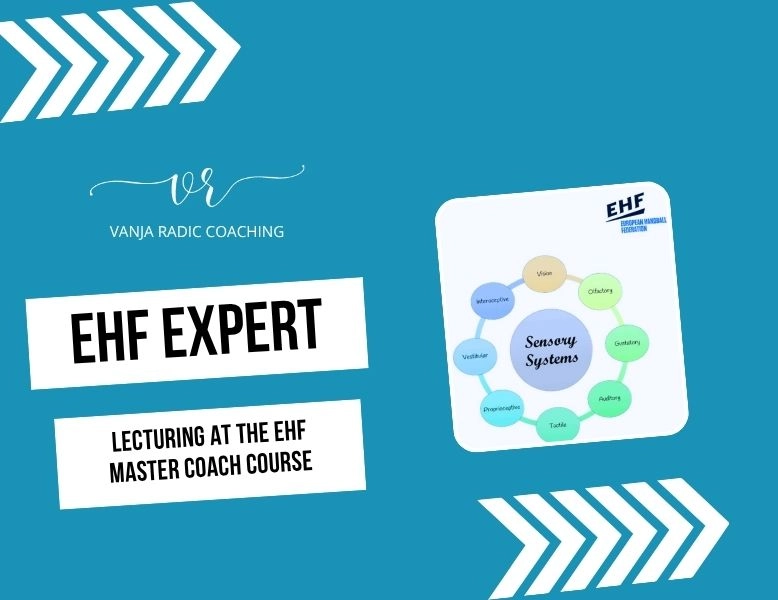
EHF Expert – Lecturing at the EHF Master Coach Course
Last week, I had the honor of delivering my first lecture as an EHF Expert at the EHF Master Coach Course, Module 2, in Porto. The topic was goalkeeper individual match and training warm-up, and I was speaking to coaches from across Europe who had committed to reaching the highest levels of coaching certification that European handball offers.
Standing in front of that room, sharing ideas I’ve developed over 15 years of coaching goalkeepers in more than 30 countries, I felt something I hadn’t fully anticipated. Pride, yes. But also gratitude. Gratitude for a journey that started with questions nobody seemed to have answers to, and that led me to create my own methodology, build my own platform, and eventually be recognized by the highest institution of European handball.
This article is about that experience. But more importantly, it’s about the content I shared, specifically my approach to cognitive training in goalkeeper warm-up, and why I believe this perspective can change how coaches think about preparing their goalkeepers.
- Being recognized as an EHF Expert and lecturing at the EHF Master Coach Course represents the highest level of acknowledgment from European handball’s governing body. This recognition validates years of dedicated work in goalkeeper coaching methodology.
- Approximately 70% of all movement and postural activity is reflexively mediated by the visual system, with another 20% from the vestibular system and 10% from proprioceptive input. This means goalkeeper training should prioritize cognitive and visual development alongside physical preparation.
- Cognitive warm-up prepares the brain while physical warm-up prepares the body. The best approach combines both, activating visual tracking, decision-making, and reaction to varied stimuli within the warm-up structure.
- Effective cognitive training activates multiple brain areas simultaneously, helps goalkeepers select relevant stimuli from complex environments, and purposefully develops the visual and vestibular systems that dominate motor output.
- Goalkeeper coaching is gaining recognition at institutional levels, signaling that the specialized knowledge required to develop goalkeepers effectively is being acknowledged as essential to coach education.
What Being an EHF Expert Means to Me
The European Handball Federation’s coaching education system is comprehensive and rigorous. The EHF Master Coach Course represents the highest level of coaching certification in European handball. Being invited to lecture as an EHF Expert at this course means that the work I’ve dedicated my professional life to has been fully recognized, accepted, and acknowledged by the governing body of European handball.
I don’t take this lightly.
For years, I worked in relative isolation, developing my coaching methodology, publishing articles and videos on my website, traveling to countries where coaches wanted to learn about goalkeeper training. I did this because I believed in the importance of proper goalkeeper coaching, not because I expected recognition from institutions.
When the invitation came to join the EHF Expert lecturing family, it validated something I had always hoped was true: that doing work you believe in, consistently and with dedication, eventually gets noticed by the people who matter.
For coaches reading this who are on their own journeys, developing their own approaches, putting in work that sometimes feels invisible, I want you to know that recognition can come. Keep going. The work matters.
The Focus of My Lecture: Cognitive Training in Warm-Up
While my lecture covered all important aspects of goalkeeper warm-up, I put special focus on something that defines much of my coaching work: cognitive training and brain training.
This isn’t a topic that gets enough attention in traditional goalkeeper education. Most warm-up protocols focus on physical preparation, getting muscles ready, increasing heart rate, improving mobility. These things matter. But they’re not the whole picture.
Goalkeeping is fundamentally a cognitive task performed through physical action. The goalkeeper must see, process, decide, and execute, all in fractions of seconds. If we only prepare the body and neglect the brain, we’re leaving performance on the table.
This perspective shaped everything I shared with the coaches at the EHF Master Coach Course. And based on their reactions, their questions, their engagement, I could tell it was landing. Coaches were curious. They wanted to understand more. They saw possibilities in their own work.


Why Visual Input Matters More Than Most Coaches Realize
Here’s something I emphasized in my EHF Expert lecture that I want to share with you.
Making the decision about goalkeeper movement in the goal is directly impacted by the quality of visual input. The visual system is one of the primary systems through which handball goalkeepers get the information they need to decide what to do and how to move.
The research on this is compelling. More than 70% of all movement and postural activity, including balance and stabilization, is reflexively mediated by the visual system. You’ll find slightly different percentages in different studies, but most researchers agree on approximately this breakdown:
- 70% from the visual system (what you see)
- 20% from the vestibular system (balance and spatial orientation)
- 10% from proprioceptive input (sense of body position)
Think about what this means for goalkeeper training. If 70% of movement output depends on visual input, and we spend almost no training time specifically developing visual processing, we’re ignoring the dominant system that drives performance.
This is why cognitive training has become central to my coaching philosophy. It’s not a nice addition. It’s addressing the primary system that determines goalkeeper success.
The Three Pillars of My Cognitive Training Approach
In my work as an EHF Expert and throughout my coaching career, I’ve developed a cognitive training approach built on three main pillars.
Activating Multiple Brain Areas
I want to engage several areas of the brain simultaneously. When we activate more brain systems at once, we improve the speed of decision-making and the speed of information processing.
Traditional training often isolates physical skills. You practice one movement pattern, repeat it, and move to the next. This has value for learning motor patterns. But it doesn’t prepare the brain for the reality of goalkeeping, where multiple cognitive demands happen simultaneously.
In my exercises, you’ll often see elements that challenge visual tracking, spatial awareness, movement selection, and physical execution all at once. This integrated approach better prepares goalkeepers for what they actually face in matches.
Selecting and Processing Relevant Stimuli
Goalkeepers face a flood of information during play. Players moving, the ball changing hands, fakes, body positions, angles, distances. Not all of this information is equally relevant to the save that needs to be made.
I want to help goalkeepers become better at selecting the most relevant stimuli from their environment and generating faster, more effective responses. This is a trainable skill. Goalkeepers who develop it make better decisions more quickly.
Exercises that include multiple stimuli, where the goalkeeper must identify which cue matters and respond accordingly, develop this selective attention. Over time, the process becomes more efficient and more automatic.
Developing Visual and Vestibular Systems
Since visual and vestibular systems account for roughly 90% of the sensory input that determines motor output, I work purposefully on developing both.
Visual training includes exercises that challenge tracking, peripheral awareness, focus shifting, and visual reaction. These aren’t separate from goalkeeper technique work. They’re integrated into it.
Vestibular training involves exercises that challenge balance and spatial orientation, often in combination with movement and decision-making tasks. This develops the system that helps goalkeepers maintain stability and spatial awareness during dynamic saves.
What the Coaches at the EHF Master Coach Course Responded To
It was very interesting to share my coaching ideas with the experienced coaches attending the EHF Master Coach Course and to see their reactions.
The questions they asked told me what resonated most. They wanted to know how to implement cognitive elements in their existing training. They asked about progressions, about how to introduce these concepts to goalkeepers of different ages and levels. They were curious about how cognitive training connects to specific save techniques.
This interaction confirmed something I’ve observed consistently: coaches recognize the importance of cognitive training when it’s explained clearly, but most haven’t received education on how to actually do it. There’s a gap between knowing it matters and knowing how to train it.
This is part of why I created my video courses and why I continue to develop educational content. The gap needs to be filled. Coaches deserve access to this knowledge.
Cognitive Warm-Up: The Practical Application
For those curious about what I actually covered in my EHF Expert lecture, here’s the essence of cognitive warm-up in handball goalkeeping.
Traditional warm-up prepares the body. Cognitive warm-up prepares the brain. The best approach combines both.
A cognitive warm-up includes elements that:
- Activate visual tracking and focus
- Challenge reaction to varied stimuli
- Engage decision-making under time pressure
- Integrate movement with cognitive tasks
- Build intensity progressively from simple to complex
This doesn’t require complicated equipment or extensive extra time. It requires understanding what you’re trying to achieve and designing exercises accordingly.
A simple example: instead of having a goalkeeper react to balls thrown to predetermined locations, add a visual cue that determines which location. Now the goalkeeper must see, process, and react rather than just react. The physical movement is the same. The cognitive demand is higher. The training effect is greater.
Building complexity from there involves multiple cues, competing information, faster timing, and integration with goalkeeper-specific movement patterns.
Why This Recognition Matters for Goalkeeper Coaching
Being accepted as an EHF Expert represents more than personal achievement. It represents recognition that goalkeeper coaching deserves specialized attention at the highest levels of coach education.
For too long, goalkeeper training has been an afterthought in many coaching curricula. Team coaches learn about offense, defense, and overall team management. Goalkeeper-specific education often receives minimal attention.
The fact that the European Handball Federation invited a goalkeeper specialist to lecture at their Master Coach Course signals that this is changing. It signals that the importance of proper goalkeeper coaching is being recognized at institutional levels.
I hope this trend continues. Goalkeepers deserve coaches who understand their position deeply. And coaches deserve education that prepares them to work effectively with goalkeepers.
For Coaches Who Want to Learn More
If you’re interested in cognitive training in sport, or any topic related to goalkeeper coaching, I welcome the opportunity to work together. You can hire me for coaching cooperation, individual goalkeeper coaching, or coach mentoring.
The concepts I shared as an EHF Expert at the Master Coach Course are also woven throughout my video courses:
- Level 1 Video Course for Coaches covers basic goalkeeper technique with cognitive training principles integrated throughout
- Level 2 Video Course for Coaches addresses saves from 6 meters and wing positions with the same approach
If you want to explore cognitive training specifically, you might find my article on cognitive challenges in handball goalkeeper training helpful as a starting point.
Looking Forward
My first lecture as an EHF Expert is now behind me, but I hope it’s the first of many. The experience reinforced my commitment to sharing goalkeeper coaching knowledge as widely as possible.
Every coach who learns to integrate cognitive training into their work creates better conditions for their goalkeepers to develop. Every goalkeeper who receives this kind of training has a better chance of reaching their potential. The ripple effects extend far beyond any single lecture or course.
I’m grateful for the opportunity. I’m proud of the recognition. And I’m motivated to continue doing this work.
If you’re on your own coaching journey, wherever you are in it, I hope this story encourages you. The work you do matters. Keep developing. Keep learning. Keep sharing what you know.
Recognition may or may not come. But the impact you have on your athletes is real regardless. That’s what makes coaching worth doing.
Stay in Touch
Do you have any coaching challenges you’d like me to address? Let me know what topics you struggle with most in goalkeeper coaching by filling out this form.
Never miss an update
Subscribe to my newsletter to receive updates about my online and in-person projects, research papers, creative projects (blog posts, books, e-books), and new online programs.
My Online Video Courses:
– Level 1 Video Course for Coaches
– Level 2 Video Course for Coaches
– Sliding Technique Video Course
– Agility Ladder Drills Video Collection – 102 drills
Subject to Copyright
Unauthorized use and/or duplication of any content from this website without express written permission from this site’s owner is strictly prohibited. All content (including text, data, graphics files, images, illustrations, videos, and sound files) contained in www.vanjaradic.fi is copyrighted unless otherwise noted and is the property of Vanja Radic Coaching. If you wish to cite or use any content from my website, please contact me first to obtain permission.
No responses yet