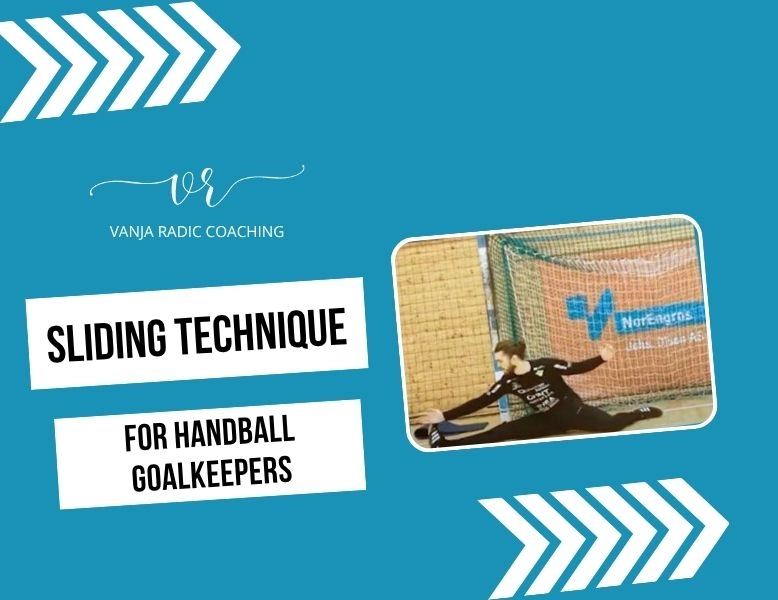
Sliding Technique for Handball Goalkeepers
The sliding technique is one of the most visually impressive save movements in handball goalkeeping. When executed properly, it allows goalkeepers to cover low, fast-moving shots directed toward the corners of the goal with efficiency and control. But it’s also one of the most misunderstood and frequently misused techniques, especially among young goalkeepers who try to copy what they see elite goalkeepers doing without understanding what makes it work.
I’ve coached goalkeepers in over 30 countries across 15 years, and this topic comes up constantly. Coaches message me asking how to teach sliding properly. They describe goalkeepers who hurt themselves trying to slide. They share videos of young players attempting sliding saves that look nothing like what the technique should be. The pattern is so consistent that I created an entire video course dedicated to sliding technique to address it systematically.
In this article, I want to share the essential knowledge that every coach needs before working on sliding technique with their goalkeepers. This isn’t about giving away every detail from my course. It’s about helping you understand the bigger picture so you can make informed decisions about when and how to introduce this technique.
Key Takeaways
- Sliding technique extends a goalkeeper’s range on low corner shots, but it’s a complex movement that requires proper physical preparation including hip mobility, flexibility, lower body strength, and core stability before it should be introduced.
- Young goalkeepers often copy what they see elite goalkeepers doing without understanding the years of preparation behind it. This “copy and paste” approach leads to poor technique and increased injury risk.
- Research shows goalkeepers have the highest percentage of non-contact injuries (48.9%) among handball positions, suggesting that repetitive movements performed incorrectly, including sliding technique, contribute significantly to overuse injuries.
- Individual readiness matters more than specific age when introducing sliding technique. Coaches should assess each goalkeeper’s physical development, movement quality, and technical foundation rather than applying blanket age rules.
- Progressive introduction is essential. Moving from component exercises through increasing complexity allows goalkeepers to develop proper motor patterns. Attempting full-speed execution before mastering mechanics embeds poor habits and increases injury risk.
What Is Sliding Technique and Why Does It Matter?
The sliding technique, sometimes called the split save or slide save, is a specialized saving movement used by handball goalkeepers to reach low shots aimed at the corners of the goal. It involves extending one leg horizontally while lowering the body toward the ground, sliding along the court surface to cover the space where the ball is traveling.
Unlike a simple step or lunge, the sliding technique combines several elements working together: the leg that extends toward the ball, the opposite leg that supports and initiates the movement, the hip trajectory that determines how the body travels, the arm positioning that protects and intercepts, and the body control that keeps everything coordinated.
When performed correctly, the sliding technique significantly extends a goalkeeper’s range on low shots. It allows goalkeepers to reach balls that would be impossible to save with other techniques. And because the body moves efficiently toward the ball rather than just reaching for it, the technique can create solid saves rather than desperate deflections.
This is why elite goalkeepers use sliding technique regularly. Watch Niklas Landin, and you’ll see him execute sliding saves that look effortless. He drops into the slide, makes the save, and returns to ready position almost instantly. It’s become one of the defining characteristics of modern handball goalkeeping at the highest level.

When Should Goalkeepers Use Sliding Saves?
Sliding technique is specifically designed for certain game situations. Understanding when to use it helps coaches teach appropriate decision-making alongside the physical technique.
Low Shots to the Corners
The primary application of sliding technique is for low shots aimed at the corners of the goal, particularly from 9 meters. When a shooter releases a low, hard shot toward either bottom corner, a goalkeeper positioned correctly in the middle of the goal often can’t reach the ball with a simple lateral step or push-off. The sliding technique extends their reach.
This connects directly to overall technique for saves of low shots from 9 meters, where goalkeepers need multiple tools for different situations.
Quick Reactions to Unexpected Directions
Sometimes a goalkeeper anticipates one direction but the shot goes elsewhere. When caught moving the wrong way or slightly out of position, the sliding technique can provide recovery options that other techniques don’t. The extended reach and body coverage can save shots that would otherwise be goals.
Situations Where Other Techniques Won’t Reach
There are shots that simply can’t be saved any other way. The combination of shot speed, placement, and goalkeeper position creates situations where only a sliding technique can close the gap. Having this tool available expands what’s possible.
When NOT to Use Sliding
Equally important is knowing when sliding technique isn’t appropriate. It shouldn’t be the default response to every low shot. It’s not ideal when a simpler technique would work. It’s unnecessary when the goalkeeper is already well-positioned. And it’s risky when the goalkeeper hasn’t developed the physical preparation to execute it safely.
Young goalkeepers often overuse sliding technique because it looks dramatic. They attempt slides when a basic side-step save would work perfectly well. Teaching appropriate use is as important as teaching the technique itself.
Why Young Goalkeepers Often Do It Wrong
Most young goalkeepers love the idea of sliding technique. They watch senior goalkeepers perform spectacular sliding saves in professional matches, and they want to do the same thing. The problem is that what looks simple on video is actually quite complex, and attempting to “copy and paste” without understanding leads to poor execution and potential injury.
The Imitation Problem
Young goalkeepers see the end result of sliding technique, the smooth, extended save that elite goalkeepers perform. What they don’t see is the years of physical preparation, the countless hours of progressive training, and the specific technical details that make it work.
When they try to imitate what they’ve seen, they typically miss critical elements. The hip trajectory is wrong. The leg positioning is incorrect. The arm coordination is off. The timing doesn’t work. The result looks nothing like the technique they were trying to copy, and it often puts their bodies in dangerous positions.
Incomplete Physical Development
Young athletes face increased injury risks due to incomplete physical development. Their strength, flexibility, and coordination are still developing. Without these foundational elements, performing sliding technique properly isn’t just difficult. It’s potentially harmful.
The sliding movement places significant demands on the hips, knees, and ankles. These joints need adequate strength and mobility to handle the stress. Young goalkeepers often lack this preparation, which means their attempts at sliding technique strain structures that aren’t ready for the load.
Lack of Technical Foundation
Sliding technique builds on more fundamental goalkeeper skills. Goalkeepers need solid basic stance, good body control, proper weight distribution, and efficient movement patterns before adding complex techniques.
When coaches skip these foundations and jump directly to teaching sliding technique, the results are predictable. Goalkeepers lack the movement vocabulary to execute the technique properly. They compensate with poor mechanics that create injury risk and limit effectiveness.
No Understanding of Progression
Learning any complex movement requires progression. You don’t go from zero to full execution in one step. You build gradually, mastering simpler versions before adding complexity.
Most young goalkeepers don’t receive this progressive instruction for sliding technique. They just try the full movement because that’s what they’ve seen. Without proper progression, they can’t develop the motor patterns that make the technique work.
The Injury Risks of Improper Sliding Technique
Research on handball injuries reveals concerning patterns for goalkeepers. According to studies published in the International Journal of Environmental Research and Public Health, goalkeepers showed that 67% of their injuries were caused by overuse and 48.9% were non-contact injuries, the highest percentage among all playing positions. This suggests that repetitive movements performed incorrectly, including sliding technique, contribute significantly to goalkeeper injuries.
Hip Injuries
The hip joint experiences significant stress during sliding technique. The movement requires the hip to move through a large range of motion while supporting body weight and generating force. Improper technique can strain hip flexors, cause adductor injuries, or contribute to hip impingement problems over time.
Studies from the Journal of Strength and Conditioning Research have found that hip flexor tightness is associated with reduced dynamic balance, which itself is a risk factor for lower limb injuries. Goalkeepers who lack adequate hip mobility before attempting sliding technique put themselves at risk.
Knee Problems
The knees are vulnerable during sliding technique, especially when executed incorrectly. The combination of lateral movement, weight transfer, and ground contact creates forces that the knee must manage.
Young goalkeepers often land with poor knee alignment during slides, letting the knee collapse inward or hyperextend. These positions increase stress on the ACL, MCL, and meniscus. Repeated improper execution can lead to chronic problems or acute injuries.
Female goalkeepers face additional considerations due to anatomical differences including Q-angle and intercondylar notch width, which some research suggests may affect knee injury risk during dynamic movements.
Ankle Injuries
The ankle must provide both mobility and stability during sliding technique. The foot positioning at different phases of the movement determines how forces travel through the ankle joint.
Incorrect foot angles or improper weight distribution can sprain ankles or contribute to chronic instability. Young goalkeepers who haven’t developed adequate ankle strength and proprioception are particularly vulnerable.
The Overuse Pattern
Perhaps most concerning is the overuse injury pattern seen in goalkeepers. Unlike acute injuries from a single incident, overuse injuries develop gradually from repeated stress. Every time a goalkeeper performs sliding technique incorrectly, they add a small amount of damage. Over weeks and months, this accumulates into significant problems.
This means that teaching sliding technique incorrectly doesn’t just result in ineffective saves. It potentially creates long-term injury patterns that can affect a goalkeeper’s entire career.
Physical Prerequisites for Sliding Technique
Before teaching sliding technique, coaches need to ensure their goalkeepers have developed certain physical qualities. These prerequisites protect against injury and enable effective execution.
Hip Mobility
Hip mobility is essential for sliding technique. The movement requires the hip to flex, extend, abduct, and rotate through ranges that exceed normal daily activities. Goalkeepers with restricted hip mobility will compensate with problematic mechanics in other areas.
Specifically, goalkeepers need adequate hip flexor length, strong and mobile adductors, and good internal and external rotation. Restrictions in any of these areas limit sliding technique and increase injury risk.
I discuss the importance of hip mobility for handball goalkeepers in detail in another article. This is foundational work that should precede any sliding technique training.
Flexibility
Beyond hip mobility specifically, overall flexibility matters. The hamstrings, quadriceps, hip flexors, and groin muscles all contribute to sliding technique. Tightness in any of these areas affects execution quality and safety.
This doesn’t mean goalkeepers need extreme flexibility like gymnasts. But they need enough range of motion to perform the technique without straining at the limits of their flexibility.
Lower Body Strength
Sliding technique requires strength to execute and strength to protect the joints. The muscles around the hips, knees, and ankles need adequate strength to handle the forces involved.
Specifically, goalkeepers need strong glutes and hip stabilizers, quadriceps strength for knee control, and lower leg strength for ankle stability. Weakness in these areas leads to compensation patterns and injury vulnerability.
Core Stability
The core connects upper and lower body during sliding technique. It maintains body control throughout the movement and transfers force efficiently. Weak core stability results in sloppy technique and wasted energy.
Core training for goalkeepers should include anti-rotation and anti-flexion exercises, not just traditional ab work. The core needs to stabilize against forces in multiple directions, which is exactly what happens during sliding technique.
Proprioception and Body Control
Proprioception is the body’s sense of its position in space. Good proprioception enables goalkeepers to know where their limbs are and what they’re doing without looking. This is essential for a complex movement like sliding technique that involves multiple body parts moving simultaneously.
Body control develops through varied movement experiences. Goalkeepers who have practiced many different movement patterns develop better overall body control, which supports learning specific techniques like sliding.
Key Technical Elements of Sliding Technique
While I go into comprehensive detail about technique in my Sliding Technique Video Course, here are the key elements that coaches should understand.
Hip Trajectory
The path that the hips follow during sliding technique significantly affects both effectiveness and safety. Proper hip trajectory ensures the body moves toward the ball efficiently while distributing forces appropriately through the joints.
Incorrect hip trajectory is one of the most common problems I see. Goalkeepers drop straight down or fall backward instead of moving laterally toward the ball. This reduces reach and creates awkward positions that stress the joints.
Leg Positioning
Both legs have important roles during sliding technique. The leg extending toward the ball (the reacting leg) must position correctly to cover the target area. The opposite leg (the non-reacting leg) initiates the movement and provides support.
Common mistakes include extending the reacting leg with poor alignment, failing to use the non-reacting leg effectively, and ending up with leg positions that make recovery difficult.
Arm Coordination
The arms contribute to both balance and saving during sliding technique. The arm on the ball side (reacting arm) positions to make the save. The opposite arm (non-reacting arm) helps maintain balance and can contribute to body control.
Incorrect arm positioning is another frequent problem. Goalkeepers who neglect arm technique reduce their saving effectiveness and compromise their balance throughout the movement.
Foot Position and Contact
How the feet contact the ground at different phases of sliding technique affects force transmission, control, and safety. The angles and surfaces matter more than most people realize.
This is an area where small details make big differences. Getting foot positioning right requires attention and practice.
Body Posture
Overall body posture during sliding technique influences everything else. The angle of the torso, the position of the head, and the alignment of the spine all affect execution quality.
Good posture enables efficient movement and safe force distribution. Poor posture creates compensation patterns and vulnerability.
Common Mistakes Coaches See
Based on my experience coaching goalkeepers internationally and receiving countless videos for technique analysis, these are the most frequent mistakes with sliding technique.
Dropping Instead of Sliding
Many goalkeepers simply drop their body toward the ground rather than sliding laterally toward the ball. They end up sitting on the floor in the middle of the goal rather than extending toward the corner. This eliminates the reach advantage that sliding technique is supposed to provide.
Incorrect Hip Movement
The hips don’t follow the proper trajectory. Instead of moving toward the ball with the body, the hips drop straight down or rotate incorrectly. This puts stress on the joints and reduces effectiveness.
Poor Timing
Timing sliding technique is challenging. Goalkeepers often initiate too early or too late. Too early means they’re already on the ground before the shot is released, making adjustment impossible. Too late means they can’t complete the movement before the ball arrives.
Neglecting the Non-Reacting Side
Coaches and goalkeepers often focus exclusively on the leg and arm going toward the ball. But the opposite limbs matter just as much. The non-reacting leg initiates the movement. The non-reacting arm maintains balance. Neglecting these elements compromises the entire technique.
No Recovery Preparation
Sliding technique includes recovery, getting back to ready position after the save. Many goalkeepers learn to get down but never learn to get up efficiently. This leaves them vulnerable to follow-up shots or unable to react to rebounds.
Attempting Full Speed Before Mastering Mechanics
Goalkeepers try to perform sliding technique at match speed before they’ve mastered the mechanics at slower speeds. This embeds poor movement patterns and increases injury risk. Speed should be added only after correct mechanics are established.
When to Introduce Sliding to Young Goalkeepers
This is the question I receive most often about sliding technique. Coaches want to know the right age or the right time to start teaching it. Unfortunately, there’s no single answer that applies to every goalkeeper.
Individual Readiness Matters More Than Age
Two goalkeepers of the same age can have completely different physical development, movement experience, and technical foundations. Setting a specific age for introducing sliding technique doesn’t account for this individual variation.
Instead, coaches should assess each goalkeeper’s readiness based on the prerequisites I described earlier: hip mobility, flexibility, strength, core stability, and body control. A goalkeeper who has developed these qualities is ready for progressive sliding technique work, regardless of exact age.
Physical Maturity Considerations
That said, younger goalkeepers generally face more risk because their bodies are still developing. Growth plates remain open. Muscle strength relative to body weight is still building. Coordination is still maturing.
For most goalkeepers, the physical maturity for safely learning sliding technique develops somewhere in the early to mid teenage years. But this varies significantly between individuals. Some 14-year-olds are ready. Some 16-year-olds aren’t.
Building Foundations First
Before introducing sliding technique, ensure goalkeepers have solid foundations in:
- Basic stance and movement
- Simpler save techniques for low shots
- General athletic movement skills
- Adequate mobility and flexibility
- Basic strength development
These foundations support safe and effective learning of more complex techniques.
Progressive Introduction
When a goalkeeper is ready, introduce sliding technique progressively. Don’t jump to full-speed execution immediately. Start with component parts, practice in controlled environments, and gradually build toward match-realistic situations.
The progression I use in my video course moves through seated exercises, kneeling exercises, and then exercises from basic stance. Each phase develops specific aspects of the technique before combining them.
Monitoring Response
As goalkeepers learn sliding technique, monitor their response. Watch for signs of excessive strain, pain, or movement problems. If issues appear, slow down or return to foundational work.
Not every goalkeeper progresses at the same rate. Adjusting to individual responses is part of good coaching.
The “Sit Down” Slide Variation
Besides the standard push-off sliding technique, there’s also a “sit down” slide variation that eliminates the lateral push-off movement. This version is even more demanding on the body, particularly the hips, knees, and ankles.
I mention this because some young goalkeepers see elite players using this variation and try to copy it. But if standard sliding technique requires physical preparation, the sit down variation requires even more. It should only be introduced after standard sliding technique is well-established and the goalkeeper has developed additional physical qualities.
Watch Niklas Landin perform the sit down slide, and you’ll see him execute it and return to ready position almost instantly. That level of execution requires exceptional preparation that most young goalkeepers simply don’t have yet.
Preparation Before Sliding Work
Before any session that includes sliding technique work, proper preparation is essential.
Warm-Up Matters
The muscles, tendons, and joints involved in sliding technique need adequate warm-up before being asked to perform demanding movements. This means general cardiovascular warm-up followed by dynamic mobility work specifically targeting the hips, legs, and core.
Static stretching alone isn’t ideal preparation for dynamic movements. Active, dynamic preparation prepares the body better for what follows.
Activation Exercises
Beyond general warm-up, specific activation exercises prepare the muscle groups most involved in sliding technique. Hip flexor activation, glute activation, and core activation help ensure these muscles are ready to work properly.
Progressive Loading
Within a training session, build toward sliding work progressively. Don’t make the first exercise of the day a full-speed sliding save. Warm up with simpler movements, then progress toward more demanding ones.
What Good Sliding Technique Looks Like
When sliding technique is executed properly, several things are visible:
- The body moves toward the ball, not just down
- The hip trajectory is smooth and controlled
- The reacting leg extends with good alignment
- The non-reacting leg provides support and initiates movement
- The arms maintain balance and position for the save
- The body posture stays controlled throughout
- Recovery to ready position is efficient
When you see a goalkeeper slide with these qualities, the movement looks smooth and powerful rather than desperate and awkward. That’s the goal of proper sliding technique training.
For Coaches Who Want Complete Methodology
This article provides the framework for understanding sliding technique. But implementing proper training requires more detailed guidance.
For coaches who want my complete methodology, with 46 progressive exercises and detailed explanations, I’ve created the Sliding Technique Video Course. This 122-minute course covers everything from preparation exercises through full technique execution, with the progression I use in my own coaching work.
Whether you’re just starting to introduce sliding technique to your goalkeepers or trying to correct problems with goalkeepers who learned incorrectly, the course provides systematic guidance for developing this important skill safely and effectively.
In Conclusion
Sliding technique is a valuable tool in the handball goalkeeper’s repertoire. When executed properly, it extends reach, creates spectacular saves, and adds dimensions to a goalkeeper’s game that other techniques can’t provide.
But it’s also a technique that requires respect. The physical demands are significant. The injury risks are real. The technical details matter. Rushing to teach sliding technique before goalkeepers are ready causes more problems than it solves.
Take time to build physical prerequisites. Introduce the technique progressively. Monitor your goalkeepers’ responses. Prioritize quality over speed. These principles apply to all complex skill development, and they’re especially important for sliding technique.
Your goalkeepers will eventually develop excellent sliding saves. But getting there safely and effectively requires patience and proper methodology. The results are worth the investment.
Topics in the Sliding Technique Video Course
• How the proper sliding technique looks like;
• The most common mistakes;
• The most important things to consider (position of reacting and non-reacting arm; proper trajectory of the hips during the sliding movement; position of reacting and non reacting leg and foot)
• The importance and suggestions of exercises for proper preparation before starting to work on sliding (suggestions of exercises for the warm-up and muscle activation, which inevitably include flexibility, mobility and strengthening for the most targeted muscle groups in sliding movement)
• Suggestions of exercises for proper steps of progression in training when working on the sliding save technique (half split seated exercises, kneeling exercises and exercises that start from the basic stance)
Stay in Touch
Do you have any coaching challenges you’d like me to address? Let me know what topics you struggle with most in goalkeeper coaching by filling out this form.
Never miss an update
Subscribe to my newsletter to receive updates about my online and in-person projects, research papers, creative projects (blog posts, books, e-books), and new online programs.
My Online Video Courses:
– Level 1 Video Course for Coaches
– Level 2 Video Course for Coaches
– Sliding Technique Video Course
– Agility Ladder Drills Video Collection – 102 drills
Subject to Copyright
Unauthorized use and/or duplication of any content from this website without express written permission from this site’s owner is strictly prohibited. All content (including text, data, graphics files, images, illustrations, videos, and sound files) contained in www.vanjaradic.fi is copyrighted unless otherwise noted and is the property of Vanja Radic Coaching. If you wish to cite or use any content from my website, please contact me first to obtain permission.
No responses yet